The Note-Taking Problem Nobody Talks About
Every UX researcher takes notes during interviews. But most note-taking is transcription-lite: jotting down what the participant said, maybe flagging a surprising quote, moving on. This creates a dangerous illusion of documentation without actually capturing the interpretive work happening in real time.
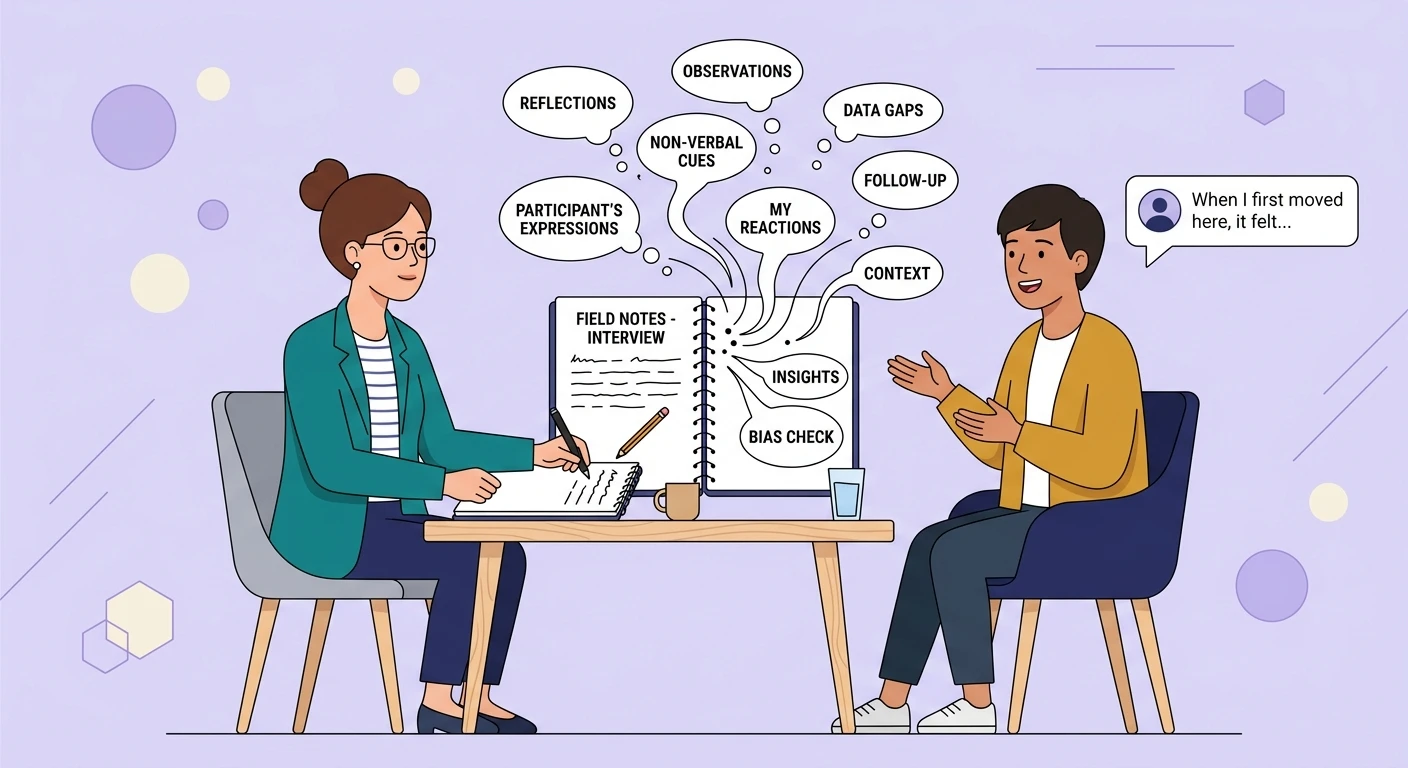
Reflexive note-taking is different. It is the practice of documenting not just what you hear, but what you think about what you hear -- your reactions, hypotheses, contradictions, and the questions that arise in the moment. It turns passive recording into active analysis.
The distinction matters because research synthesis debt compounds fastest when the gap between data collection and interpretation grows. Reflexive notes close that gap in real time.
What Reflexive Notes Actually Look Like
A standard interview note might read: "P5 said they check the dashboard every morning but rarely act on the data."
A reflexive note adds a layer: "P5 checks dashboard daily but does not act -- ritual behavior? Or is the data not actionable? This contradicts P3 who said the dashboard drives their prioritization. Possible segment difference: P5 is in ops, P3 is product. Role shapes dashboard utility?"
The reflexive layer captures the analytical thinking that would otherwise vanish between the interview and the debrief. It preserves the interpretive context that makes later qualitative data analysis dramatically more efficient.
The Cognitive Architecture of Real-Time Interpretation
Reflexive note-taking works because it externalizes working memory. During an interview, your brain is simultaneously:
- Listening to the current response
- Tracking rapport and emotional cues
- Planning the next question
- Connecting this response to prior interviews
- Noticing contradictions and patterns
Without externalization, most of this parallel processing is lost within minutes. The researcher remembers the content but forgets the connections.
This is why detecting contradictions in qualitative interviews becomes so much easier when researchers maintain reflexive notes -- the contradictions are flagged in the moment rather than reconstructed later from imperfect memory.
A Practical Framework: The Three-Column Method
The most effective reflexive note-taking uses a simple three-column structure:
Column 1: Observation -- What the participant said or did (factual)
Column 2: Interpretation -- What it might mean, connections to other data
Column 3: Implication -- What it suggests for the research question or product
This structure forces the researcher to move beyond transcription in real time. It also creates an audit trail of interpretive decisions that supports transparency when presenting research findings to stakeholders.
How AI Changes the Equation
Traditionally, reflexive note-taking required splitting attention between deep listening and documentation -- a genuine cognitive tradeoff. AI transcription changes this equation fundamentally.
When the factual layer (what was said) is handled by real-time transcription, the researcher's cognitive bandwidth is freed entirely for the interpretive layer. You no longer need to capture quotes because the system captures everything. Your job becomes pure analysis: what does this mean, how does it connect, where does it contradict.
This is not a minor efficiency gain. It transforms the interview from a documentation exercise into a live analysis session. The researcher who masters this shift produces richer data from fewer interviews because each session generates not just raw material but partially-processed insight.
Teams using AI-augmented research workflows report that the combination of automated transcription and reflexive noting reduces time-to-insight by 40-60% compared to traditional note-then-analyze approaches.
Common Mistakes in Reflexive Note-Taking
Over-interpreting early. The first interview is not the place for grand theories. Early reflexive notes should be tentative: "Possible pattern?" not "This proves X."
Conflating observation and interpretation. Keep the columns separate. "P5 seemed frustrated" is interpretation. "P5 paused for 8 seconds, then said 'I guess it works'" is observation.
Neglecting self-reflexivity. Your reactions are data too. "I felt defensive when P5 criticized the onboarding -- why? Am I too attached to this feature?" This level of honesty is what separates reflexive practice from simple note-taking.
Stopping after the interview. The richest reflexive notes often come in the 10 minutes immediately after a session ends, when connections crystallize. Block post-interview time as non-negotiable.
Building the Habit
Reflexive note-taking is a skill that improves with practice. Start with one reflexive annotation per question block. As the practice becomes automatic, you will find yourself generating interpretive notes continuously without disrupting conversational flow.
The payoff is substantial: researchers who maintain reflexive notes consistently report that their affinity mapping sessions move twice as fast because half the analytical work is already done by the time they sit down with their data.
The Bottom Line
Reflexive note-taking is not extra work layered on top of interviews. It is the interview practice that makes everything downstream -- coding, synthesis, reporting -- dramatically faster and deeper. The researchers who adopt it do not go back.
In a world where AI handles the mechanical aspects of documentation, the human researcher's unique value is exactly this: real-time interpretive intelligence applied to lived human experience. Reflexive notes are how you capture that intelligence before it fades.
*Want to see how AI-powered transcription frees your attention for reflexive analysis? Book a demo to explore how Qualz supports the full interview-to-insight workflow.*