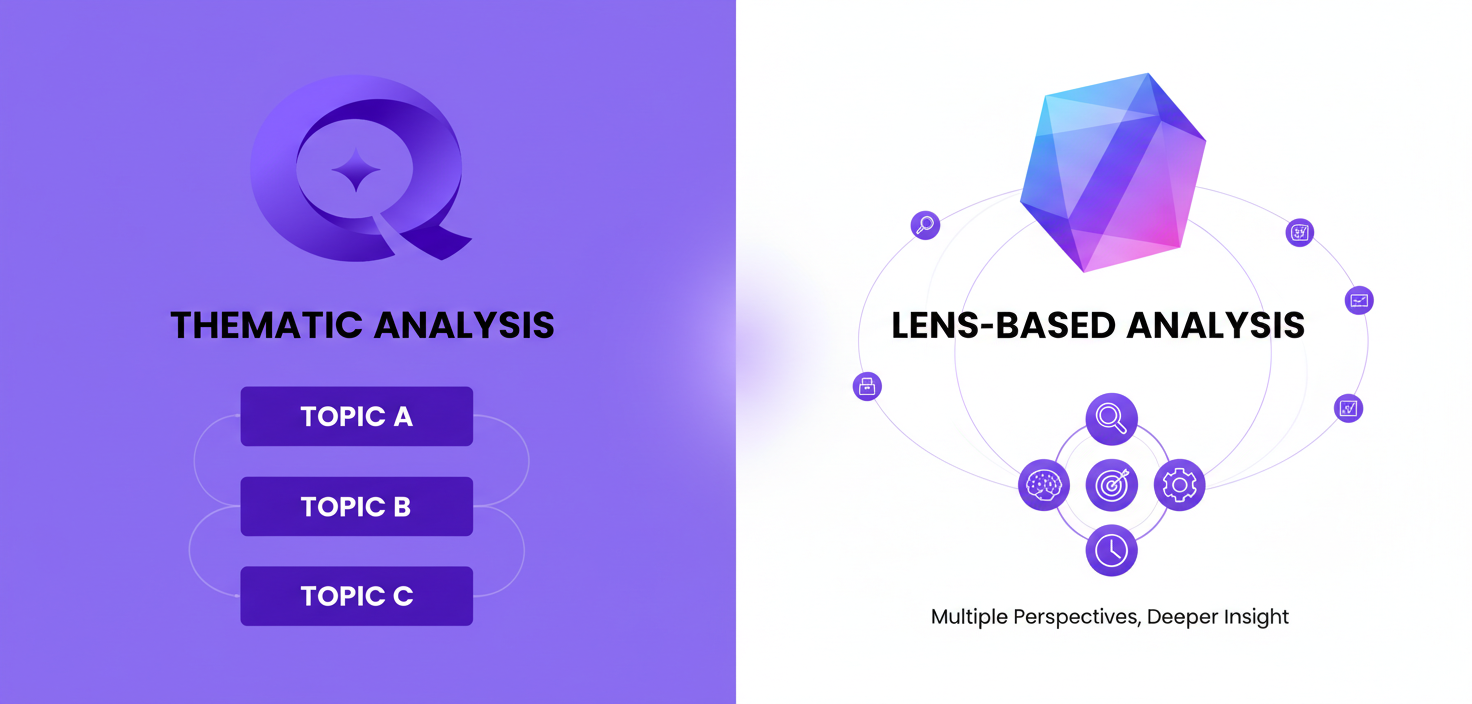
Two dominant approaches to qualitative analysis—thematic and lens-based—serve different research needs. Here's how to choose.
Thematic Analysis (Bottom-Up)
What It Is
Thematic analysis starts with raw data and works upward:
- Read transcripts with minimal preconceptions
- Identify recurring patterns (codes)
- Group codes into categories
- Derive themes from categories
- Interpret themes to answer research questions
When to Use
- Exploratory research: You don't know what you'll find
- Grounded theory: Building theory from data
- New domains: Limited existing frameworks apply
- Stakeholder variety: Multiple perspectives need equal weight
Strengths
- Lets data speak for itself
- Discovers unexpected insights
- Minimizes researcher imposition
- Appropriate for complex, novel topics
Limitations
- Time-intensive
- Requires researcher skill
- Results can be hard to replicate
- May miss theoretically important elements
Lens-Based Analysis (Top-Down)
What It Is
Lens analysis applies predetermined frameworks:
- Select relevant analytical lenses
- Apply each lens to data systematically
- Extract insights through each lens
- Synthesize cross-lens findings
Common Lenses
- Jobs-to-be-Done
- Customer journey mapping
- Pain points and gains
- Emotional response patterns
- Behavioral triggers
When to Use
- Targeted questions: You know what you're looking for
- Comparative research: Need consistent dimensions across studies
- Stakeholder requirements: Specific frameworks requested
- Time constraints: Faster than bottom-up coding
Strengths
- Efficient and focused
- Consistent across analysts
- Easy to compare across studies
- Clear deliverable structure
Limitations
- May miss emergent patterns
- Framework bias
- Less discovery-oriented
- Dependent on lens selection
Side-by-Side Comparison
| Dimension | Thematic | Lens-Based |
|---|---|---|
| Direction | Bottom-up | Top-down |
| Starting point | Raw data | Framework |
| Time required | Higher | Lower |
| Discovery potential | Higher | Lower |
| Consistency | Variable | High |
| Best for | Exploration | Validation |
Hybrid Approaches
Many projects benefit from combining methods:
Sequential
- Start with thematic analysis to discover patterns
- Apply lens analysis to structure findings for stakeholders
Parallel
Run both simultaneously:
- Thematic analysis for discovery
- Lens analysis for targeted insights
- Compare and integrate findings
Iterative
- Initial lens analysis for quick insights
- Thematic analysis on surprising data segments
- Refine lenses based on discoveries
Practical Decision Guide
Choose Thematic When:
- Research question is "What's happening here?"
- Stakeholders want to be surprised
- Topic is novel or under-researched
- You have skilled analysts and time
Choose Lens-Based When:
- Research question is "How does X compare to Y?"
- Stakeholders need specific framework outputs
- Building on prior research
- Timeline is constrained
Qualz.ai supports both approaches—from automated thematic analysis with grounded emergence to 14 pre-built analytical lenses—letting you choose the right method for each project.