AI-powered synthetic users can accelerate early validation cycles—when used appropriately. Here's how to leverage them effectively.
What Are Synthetic Users?
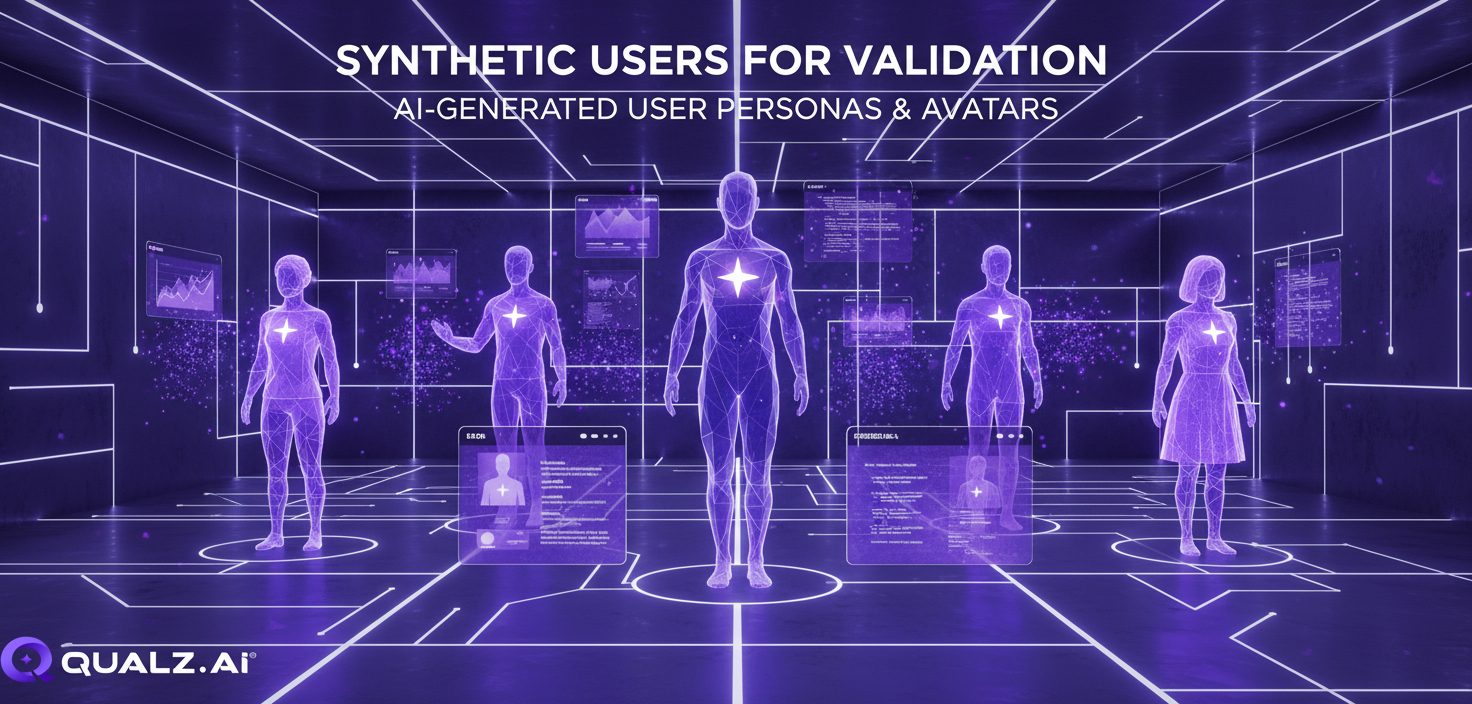
Synthetic users are AI-generated personas that simulate real user responses based on defined characteristics:
- Demographics
- Behavior patterns
- Needs and motivations
- Domain knowledge
They respond to questions and scenarios as their persona would.
Appropriate Use Cases
Concept Screening
Before investing in real user research, screen concepts:
- Generate initial reactions from diverse personas
- Identify obviously flawed concepts early
- Prioritize which concepts warrant real-user testing
Question Testing
Test interview guides before deployment:
- Check if questions make sense
- Identify confusing language
- Refine probing logic
Hypothesis Generation
Generate starting hypotheses:
- What might users care about?
- What objections might arise?
- What use cases might emerge?
Extreme Personas
Explore edge cases:
- How might power users respond?
- What about complete novices?
- What about skeptics?
Inappropriate Use Cases
Final Validation
Never make go/no-go decisions based solely on synthetic data.
Pricing Research
Real willingness-to-pay data requires real users.
Emotional Research
AI cannot authentically replicate human emotional responses.
Regulatory Compliance
Studies requiring human subjects approval cannot use synthetics.
Implementation Framework
Step 1: Define Personas
Create detailed persona profiles:
- Background and context
- Goals and frustrations
- Technology comfort
- Domain experience
Step 2: Calibrate Responses
Test personas against known data:
- Compare synthetic responses to real data from similar users
- Adjust persona definitions for better alignment
- Document calibration process
Step 3: Generate Insights
Run synthetic research:
- Treat as exploratory, not conclusive
- Note patterns and hypotheses
- Flag for real-user validation
Step 4: Validate with Real Users
Confirm synthetic findings:
- Test top hypotheses with real users
- Note alignment and divergence
- Refine synthetic models based on comparison
Sample Workflow
| Phase | Activity | Synthetic Users | Real Users |
|---|---|---|---|
| 1 | Concept screening | 50 responses | 0 |
| 2 | Concept refinement | 20 responses | 5 interviews |
| 3 | Detailed validation | 0 | 15 interviews |
| 4 | Final confirmation | 0 | Survey (n=200) |
Quality Indicators
Good Synthetic Data
- Responses vary appropriately by persona
- Language feels authentic to persona
- Unexpected but plausible insights emerge
- Calibration shows reasonable real-user alignment
Poor Synthetic Data
- All personas respond similarly
- Responses feel generic or scripted
- No surprising insights
- Significant divergence from real user validation
Ethical Considerations
Transparency
Always disclose synthetic data in research reports.
No Substitution
Synthetic data supplements, never replaces, real user research.
Bias Awareness
Synthetic users inherit biases from their training data.
Qualz.ai's AI Participants feature enables rapid synthetic validation with customizable personas—helping teams move faster while maintaining methodological awareness.