The Clarity Problem
AI summarization tools are designed to reduce information. They compress a 60-minute interview into a page of clear, organized text. They extract key points, identify themes, and present findings in digestible paragraphs. This is exactly what makes them dangerous for qualitative research.
Qualitative data derives its value from richness, not clarity. The halting sentence where a participant changes direction mid-thought. The contradiction between what they said at minute 12 and what they said at minute 45. The long pause before answering a seemingly simple question. The qualifier they added that undermined their own confident statement. These are not noise to be filtered -- they are the signal.
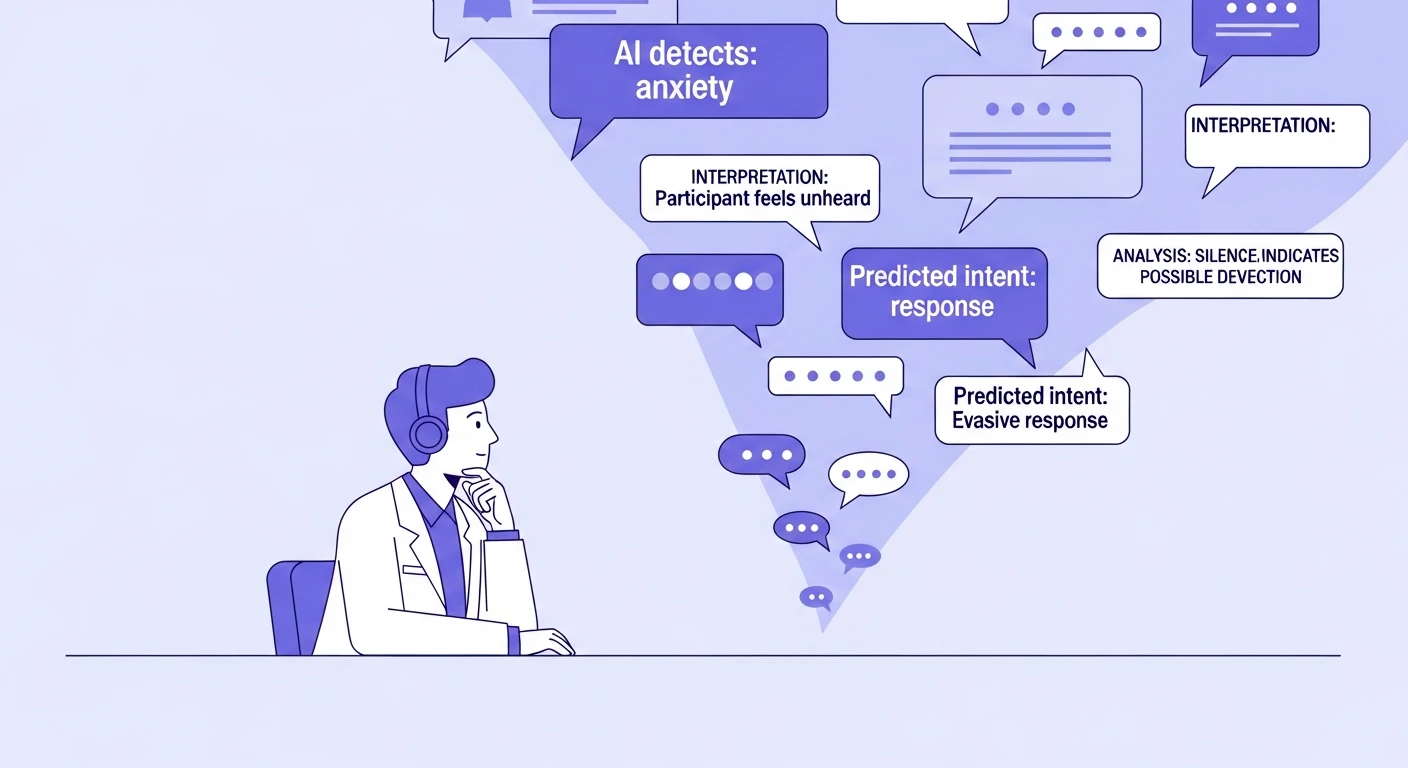
When an AI summarizes an interview, it performs a series of analytical decisions that researchers would normally make deliberately: which statements matter, which are redundant, which contradict each other (and which contradiction to resolve in favor of), and what overall narrative the data supports. The summary presents these decisions as neutral compression. They are not. They are premature analysis disguised as efficient documentation.
How Summarization Destroys Data
Ambiguity Resolution
Human speech is inherently ambiguous. When a participant says "I guess the onboarding was fine... I mean, I got through it," they are communicating something importantly different from "the onboarding was fine." The hedge, the pause, the qualification -- these signal that their actual experience was more complex than the surface statement suggests.
AI summarization resolves ambiguity by default. It picks the most likely interpretation and presents it as fact. "Participant found onboarding adequate but unremarkable" flattens the rich ambiguity of the original statement into a clean data point that supports exactly one interpretation.
Researchers who work from summaries rather than transcripts lose access to the ambiguity that would have prompted deeper probing in analysis. They never see the hedges that would have made them ask "what is really going on here?" The summary has already answered that question for them -- incorrectly.
Contradiction Suppression
Participants routinely contradict themselves within a single interview. They say they value simplicity, then describe wanting twelve additional features. They report high satisfaction, then list five frustrations. They claim they never use a feature, then describe a workflow that depends on it.
These contradictions are not data quality problems -- they are the most analytically valuable signals in qualitative data. They reveal the gap between stated preference and actual behavior, between conscious narrative and lived experience, between social performance and genuine attitude.
AI summarizers handle contradictions by either omitting one side or smoothing them into coherent narratives. "While the participant expressed some frustration with specific features, overall they found the product valuable" resolves a genuine contradiction into a false synthesis. The original data contained productive tension; the summary contains false clarity.
Emotional Flattening
Affect matters in qualitative data. The intensity of frustration, the enthusiasm behind a suggestion, the resignation in accepting a workaround -- these emotional registers communicate meaning that content alone does not capture. A participant who says "I just gave up and used Excel" with audible frustration is communicating something fundamentally different from one who says the same words with a shrug.
Summarization strips emotional texture. Every statement becomes equally weighted, equally calm, equally rational. The emotional coding that gives qualitative analysis its affective analytical layer becomes impossible when working from flattened summaries rather than rich transcripts.
Context Collapse
Statements in interviews derive meaning from their conversational context -- what was said before, what question prompted them, what the participant was reacting to. The same words mean different things depending on whether they emerged spontaneously or in response to a leading probe, whether they came at minute 5 or minute 50, whether they followed a long silence or arrived immediately.
Summarization decontextualizes by design. It extracts statements from their conversational embedding and reorganizes them thematically. The result is a document where every statement appears to have equal standing, regardless of the conversational dynamics that produced it. This is precisely the decontextualization problem at industrial scale -- automated rather than manual, and therefore harder to detect and correct.
The Efficiency Seduction
Stakeholder Demand for Speed
Product managers want insights by Friday. Leadership wants the key findings in a Slack message. The research team has twelve interviews to process before the sprint planning meeting. AI summarization promises to close this gap -- turning raw interviews into shareable deliverables in minutes rather than days.
This pressure is real, and the efficiency gain is genuine. But efficiency in compression is not the same as efficiency in analysis. Faster delivery of flattened summaries is not faster research -- it is faster destruction of the data that makes research valuable. The speed feels like progress because it satisfies stakeholder demand, not because it produces better decisions.
The Apparent Completeness Illusion
AI summaries feel comprehensive. They cover all topics discussed, mention all features referenced, and note all expressed sentiments. The reader feels they have consumed the interview -- that reading the summary is functionally equivalent to listening to the recording.
This apparent completeness is the most dangerous feature of AI summarization. It creates confidence without grounding. A stakeholder who reads five interview summaries feels they understand the users -- and they do understand the version of users that the summarizer constructed. But that construction involved hundreds of analytical decisions the stakeholder never saw and cannot evaluate.
The parallel to how AI governance frameworks require transparency about automated decision-making is direct: when AI makes analytical choices in research summarization, those choices should be visible and auditable, not hidden behind apparent objectivity.
When Summarization Is Appropriate
Operational Research Management
Summarization has legitimate uses in research operations: tracking which topics have been covered across interviews, identifying which participants discussed which themes, and creating navigation aids for large data sets. These operational uses treat summaries as indexes rather than as analytical products -- pointers back to the source data rather than replacements for it.
Preliminary Triage
For high-volume research with dozens of interviews, summaries can help researchers triage which interviews to analyze deeply. A summary that flags contradictions, emotional intensity, or unusual responses can direct analytical attention -- as long as the deep analysis happens on the original data, not on the summary itself.
Stakeholder Communication (With Caveats)
Summaries can serve as stakeholder-facing communication artifacts -- but only when clearly labeled as lossy compression rather than presented as findings. "Here is what the AI extracted" is fundamentally different from "here is what we found." The distinction matters for how stakeholders weight the information in their decision-making.
Better Approaches
AI-Assisted Annotation Rather Than Summarization
Instead of summarizing interviews, use AI to annotate them: flagging moments of contradiction, marking emotional intensity, identifying topic shifts, and highlighting statements that diverge from other participants. Annotation preserves the original data while adding navigational metadata that aids human analysis.
This approach keeps the researcher in the analytical loop rather than outsourcing analysis to the summarizer. The AI handles pattern-flagging at scale; the human handles interpretation with full contextual access.
Progressive Disclosure Summaries
If summaries are necessary, structure them as progressive disclosure layers rather than flat documents. Level 1: one-paragraph orientation. Level 2: key tensions and contradictions (unresolved). Level 3: notable quotes in conversational context. Each level links back to the timestamp in the original recording.
This design acknowledges that different consumers need different depths while ensuring that no consumer can mistake a compression layer for a complete analytical product.
The Structured Output Approach
The principle behind structured output engineering for production AI applies to research summarization: constrain what the AI produces rather than accepting unconstrained generation. Instead of "summarize this interview," specify: "List all self-contradictions. List all hedged statements. List all moments of emotional intensity. List all unprompted topic introductions." Structured extraction preserves analytical value in ways unconstrained summarization cannot.
Methodological Transparency
When AI summarization is used in any stage of the research process, document it explicitly in the methodology section. Which interviews were summarized? What model was used? What information was the summary asked to extract vs. what it was allowed to discard? This connects directly to the broader imperative for methodological transparency in AI-assisted research -- making automated analytical decisions visible rather than hiding them behind efficiency narratives.
Practical Takeaways
- Never analyze from summaries. Use original transcripts or recordings for all analytical work. Summaries are navigation aids, not analytical inputs.
- Label summaries as lossy compression. When sharing with stakeholders, make clear that the summary represents AI-constructed interpretation, not raw findings.
- Prefer annotation over summarization. Ask AI to flag patterns, contradictions, and notable moments rather than compressing entire interviews into paragraphs.
- Preserve productive ambiguity. When a participant hedges, contradicts, or hesitates, treat this as signal to investigate -- not noise to filter.
- Audit summarizer decisions. Periodically compare summaries against source transcripts to identify what the summarizer systematically discards. These patterns reveal analytical bias.
- Structure extraction requests. Instead of open-ended summarization, specify exactly what the AI should extract and in what format. Constrained extraction preserves more analytical value than unconstrained compression.
- Measure summary-induced confidence. Track whether stakeholders who consume summaries express inappropriate certainty about user needs. Over-confidence from limited data is a key indicator of summarization damage.
The summarization trap is seductive because it solves a real operational problem. Research teams genuinely need faster ways to process qualitative data. But the solution cannot be destroying the properties that make the data qualitative in the first place. Speed that sacrifices ambiguity, contradiction, and emotional texture is not research efficiency -- it is research abandonment dressed in the language of productivity.