The Case for Hypothetical Questions
Conventional qualitative research wisdom warns against hypothetical questions. "Ask about what people did, not what they would do," goes the standard guidance. And for simple preference questions, this advice holds. But for complex decisions involving tradeoffs, social pressure, or organizational politics, scenario-based questions access a layer of truth that retrospective questions cannot reach.
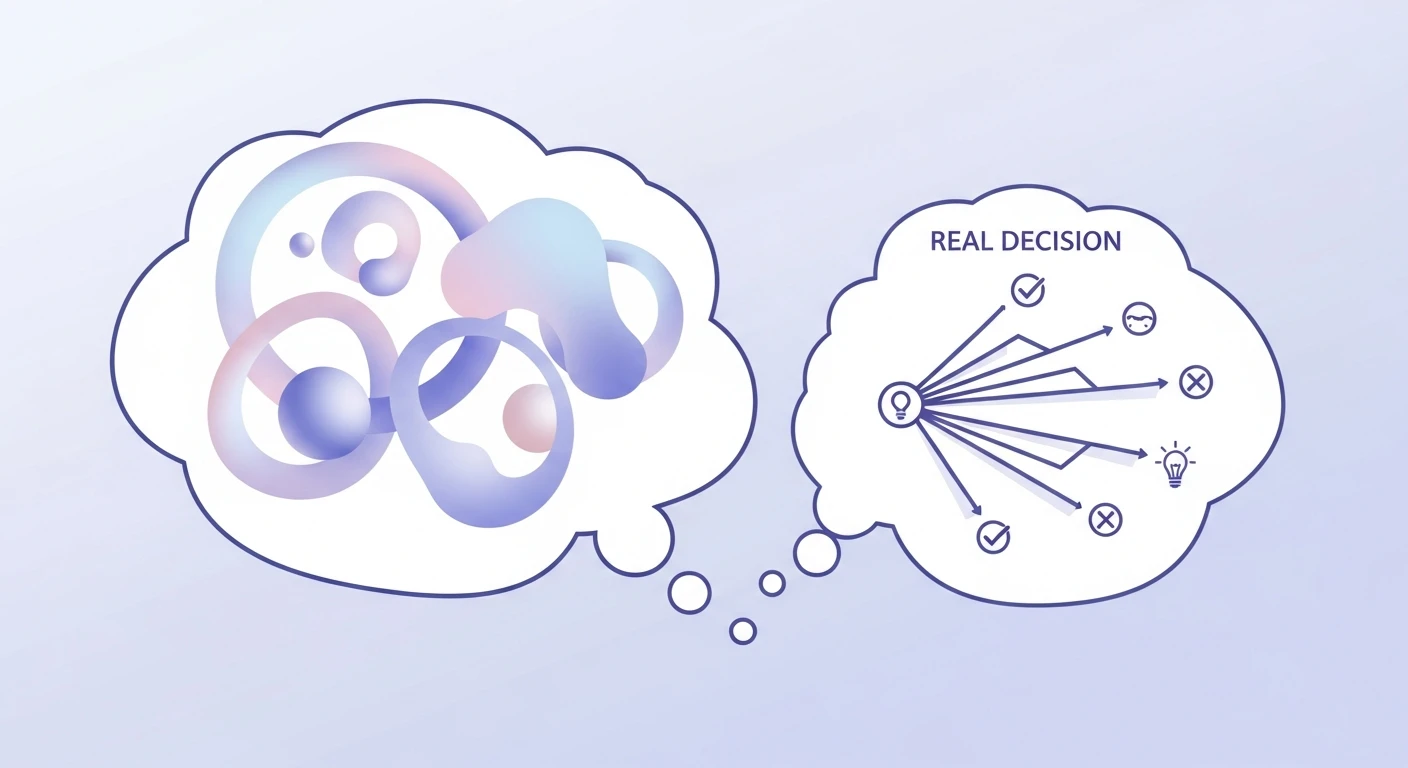
The reason is straightforward: when you ask someone to recall a past decision, they give you a post-hoc rationalization. Memory reconstructs a logical narrative from what was actually a messy, emotional, context-dependent process. But when you present a realistic scenario and ask them to think through it in real time, you observe their actual decision architecture — the criteria they weigh, the factors they dismiss, the tradeoffs they find genuinely difficult.
This approach complements what we know about how probing techniques extract depth. Scenarios are not replacements for behavioral questions — they are a different lens that reveals different structures.
When Scenarios Outperform Retrospective Questions
Socially sensitive decisions. Ask a manager "How do you decide who to promote?" and you get the official narrative: merit, performance reviews, stretch assignments. Present a scenario with two candidates — one with better metrics and one with stronger team relationships — and watch the real criteria surface. The hypothetical provides cover for honest reasoning that direct questions make socially risky.
Novel situations without precedent. When researching how users would respond to a feature that does not exist yet, retrospective questions are impossible. But well-constructed scenarios that embed the core decision dynamics reveal how people actually think. This is not asking "Would you use this feature?" (which produces meaningless yes-rates). It is asking "Here is a situation where X happens — walk me through how you would handle it" and observing the reasoning process.
Multi-stakeholder tradeoffs. Complex B2B purchase decisions involve competing priorities across departments. Asking "How did you choose your last vendor?" gets a sanitized committee narrative. A scenario that surfaces real tension — "Budget is tight, IT wants security certification, your team wants fast implementation, and your CFO wants the cheapest option: how do you navigate this?" — reveals the actual power dynamics and decision criteria.
Ethical gray areas. Ask a researcher "Do you ever cut corners on informed consent?" and you get denial. Present a scenario: "You have three days before the stakeholder presentation, you need five more interviews, and scheduling is impossible through your normal consent workflow. What would you do?" The response reveals actual practice norms, not idealized standards.
Designing Effective Scenarios
The difference between useful scenarios and pointless hypotheticals comes down to construction quality:
Ground scenarios in real context. Do not ask "Imagine you need to buy software." Ask "It is Tuesday morning, your team just lost access to the tool you have been using for a year because the vendor raised prices 40%. You have three active projects with deadlines next week. Walk me through what happens next." The specificity forces participants out of abstract reasoning and into situated decision-making.
Embed genuine tension. Every effective scenario contains an unresolvable tradeoff. If there is an obviously correct answer, you learn nothing. The tension should mirror real decisions the participant faces in their work — validated through prior research or domain expertise. This tension is what makes detecting contradictions in interviews so productive: the scenario creates conditions where contradictions naturally emerge.
Calibrate plausibility carefully. Scenarios must be realistic enough that participants engage seriously but not so close to their actual situation that they become defensive. The sweet spot is adjacent plausibility — different enough to feel safe, similar enough to activate real reasoning patterns.
Build in decision points, not single choices. The best scenarios unfold as narratives with multiple moments where the participant must decide something. "Okay, you chose Option A. Now a week has passed and you discover it does not integrate with your existing system. What do you do?" This sequential structure reveals decision resilience, reversal thresholds, and escalation patterns.
The Scenario Interview Protocol
A full scenario-based interview follows a specific arc that differs from standard semi-structured approaches:
Phase 1: Context establishment (5 minutes). Understand the participant's real professional context. Their role, team size, decision authority, current tool stack. This information lets you adapt scenarios to their reality in real time.
Phase 2: Warm-up scenario (5 minutes). Present a low-stakes scenario to establish the format. "A new team member starts next Monday. They will need access to your core systems. Walk me through what happens." This normalizes the think-aloud-through-a-scenario format without touching sensitive territory.
Phase 3: Core scenarios (25-30 minutes). Present 2-3 carefully designed scenarios that target your research questions. Give participants time to think. Follow up on specific decision points. Ask "What would change your mind about that choice?" to probe decision boundaries. Use silence strategically — scenario responses often arrive in waves as participants think through implications.
Phase 4: Reality bridge (5-10 minutes). Connect scenarios back to real experience. "The scenario we discussed with the vendor change — has anything like that actually happened to you?" This creates an opening for retrospective data that has been primed by scenario-based reasoning, often producing richer recall than cold retrospective questions.
Analyzing Scenario Data
Scenario interview data requires its own analytical framework:
Decision criteria extraction. Map every factor the participant weighs across all scenarios. These criteria reveal their decision architecture independent of any single choice.
Threshold identification. Note the conditions under which participants change their approach. "I would do X unless..." statements identify decision boundaries that matter for product design.
Reasoning pattern categorization. Some participants optimize for speed, others for consensus, others for risk minimization. The pattern across scenarios reveals their meta-strategy. Organizations building AI governance frameworks recognize this same principle: understanding how people actually make decisions under uncertainty is prerequisite to designing systems that support good decision-making.
Inconsistency analysis. When participants contradict themselves across scenarios, the contradiction is the finding. It reveals which factors are genuinely in tension for them and where their stated values diverge from their operational priorities.
Common Mistakes
Too abstract. "Imagine you need to choose between two products" gives you nothing. Ground every element in specific, tangible detail.
Leading the witness. "In this scenario where the company clearly needs better security..." has already signaled the correct answer. Present scenarios neutrally so participants reveal their own priorities.
Single-outcome focus. Do not just ask what they would choose — ask what happens next. The downstream reasoning is often more revealing than the initial decision. This connects to the principle that research debriefing practices after the session often surface insights missed during live observation.
Ignoring emotional responses. When a participant laughs, sighs, or says "Oh, that is a tough one" — that reaction data matters. Scenarios that provoke emotional responses are scenarios that hit real tension points. Note these reactions alongside the verbal reasoning.
Integration With Other Methods
Scenario-based interviews produce the most value when combined with behavioral data. Use scenarios to generate hypotheses about decision architecture, then validate with observational data, usage analytics, or diary studies that capture behavior over time. The scenario reveals the structure; other methods confirm it operates in practice.
This combination addresses the fundamental limitation of all interview-based research: people do not always do what they say they would do. But the reasoning patterns surfaced through scenarios — the criteria, the tradeoffs, the thresholds — tend to be stable even when specific choices vary. That structural insight is what makes scenario data uniquely valuable for product strategy.