Consulting firms live and die by research. Client engagements depend on gathering insights faster and deeper than clients could achieve themselves.
But research capacity is constrained. Senior researchers are expensive. Junior researchers need supervision. Recruitment takes time. Analysis is labor-intensive.
The result: firms turn down work, extend timelines, or sacrifice depth for speed. None of these are good options.
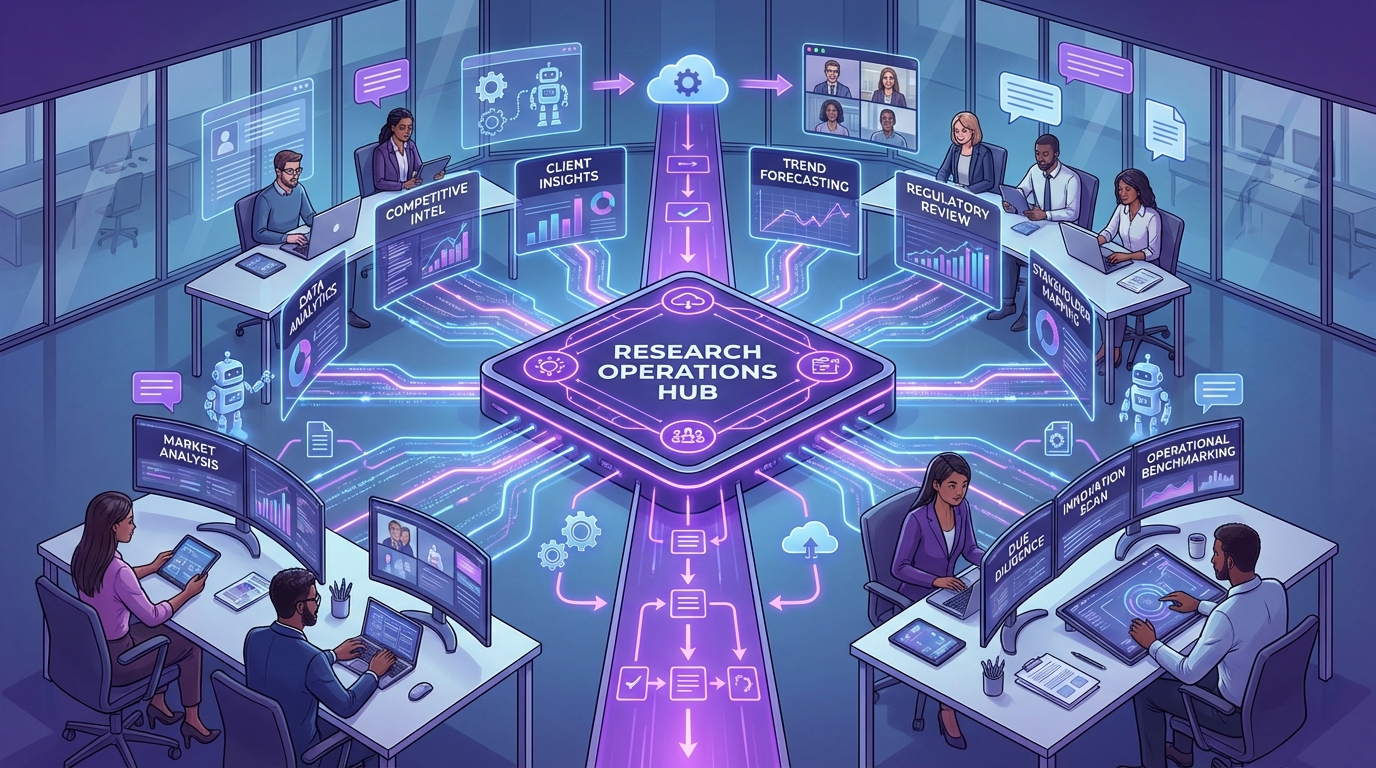
Modern research operations can change this equation, enabling firms to multiply research capacity without proportionally growing headcount.
The Capacity Constraints
Understanding constraints helps identify solutions:
Researcher Bandwidth
A skilled qualitative researcher can effectively manage perhaps 30-40 interviews per month while maintaining quality. That's the constraint on raw data collection.
Analysis Bottlenecks
Analysis typically takes longer than data collection. A researcher who conducts 10 interviews might need 20-30 hours to analyze them thoroughly.
Recruitment Logistics
Scheduling interviews, managing consent, tracking participation—administrative work consumes researcher time that should go to insight generation.
Knowledge Transfer
Insights locked in individual researchers' heads aren't scalable. Documentation, codification, and knowledge management are perpetual challenges.
Quality Consistency
As firms grow, maintaining consistent methodology and quality across projects and practitioners becomes harder.
The 10x Opportunity
Modern research tools and operations can address each constraint:
AI-Assisted Data Collection
AI-moderated interviews can conduct conversational research at scale:
Traditional: One researcher conducts 30 interviews/month maximum
AI-assisted: Same researcher oversees 150+ AI-conducted interviews/month
The researcher's role shifts from conducting to designing, overseeing, and interpreting. Capacity multiplies.
Automated Analysis
AI-powered analysis processes transcripts through multiple analytical lenses in minutes:
Traditional: 2-3 hours of analysis per interview hour
AI-assisted: Initial analysis in minutes, researcher time goes to interpretation and synthesis
The researcher's role shifts from coding to validating, challenging, and synthesizing AI-generated insights.
Streamlined Operations
Modern platforms handle logistics:
- Participant recruitment and screening
- Consent management and documentation
- Scheduling and reminders
- Transcription and organization
- Audit trail maintenance
Researchers do research; systems handle administration.
Codified Methodology
Platform-embedded methodology ensures consistency:
- Standardized interview protocols
- Consistent analytical frameworks
- Documented processes
- Quality checkpoints
Junior researchers produce consistent output because the system guides them.
Institutional Knowledge
Centralized platforms accumulate learning:
- Searchable transcript databases
- Reusable interview guides
- Cross-project theme libraries
- Client-specific knowledge bases
Insights compound instead of dissipating.
Implementing Research Operations
Phase 1: Audit Current State
Before changing anything, understand your current operations:
Capacity inventory
- How many interviews/surveys can you conduct monthly?
- What's the analysis timeline for typical projects?
- Where are the bottlenecks?
Process mapping
- What does your research workflow look like?
- Where is time spent?
- What's automated vs. manual?
Quality assessment
- How consistent is methodology across practitioners?
- How do you ensure quality?
- What's your documentation practice?
Phase 2: Prioritize Improvements
Not everything needs fixing at once. Prioritize by:
Impact on capacity: What changes would most increase throughput?
Implementation effort: What can you change quickly?
Risk tolerance: What changes require careful piloting?
Common high-impact, lower-risk starting points:
- Automated transcription
- AI-assisted analysis supplementing (not replacing) human analysis
- Centralized project management
Phase 3: Pilot and Learn
Don't transform everything simultaneously. Pilot changes on:
- Lower-stakes internal projects
- Willing client engagements
- Specific project phases (e.g., just analysis)
Document what works and what doesn't. Iterate before scaling.
Phase 4: Scale Systematically
As pilots succeed, expand systematically:
- Train additional practitioners
- Develop standard operating procedures
- Build quality assurance processes
- Create feedback loops for continuous improvement
Organizational Considerations
Researcher Role Evolution
Research operations changes what researchers do, not whether they're needed:
Before: Researchers conduct, transcribe, code, analyze, and present
After: Researchers design, oversee, interpret, synthesize, and present
The value shifts from labor to judgment. That's a skill transition some researchers embrace and others resist. Plan for change management.
Quality Assurance
Increased volume requires enhanced quality processes:
- Review protocols for AI-generated output
- Calibration sessions across practitioners
- Client feedback integration
- Continuous methodology refinement
More research happening doesn't help if quality suffers.
Client Communication
Some clients are excited about AI-assisted research. Others are skeptical. Be transparent:
- Explain what AI does and doesn't do
- Clarify human oversight and interpretation
- Highlight benefits (speed, consistency, scale)
- Address concerns proactively
Pricing Models
Research operations enable different economics:
- Fixed-price projects become more viable
- Per-participant pricing for scaled research
- Subscription models for ongoing research relationships
- Premium pricing for rapid turnaround
Align pricing with the value you're creating, not just the hours you're spending.
Case Example: Strategy Consulting Firm
A mid-size strategy firm wanted to expand qualitative research offerings but couldn't justify additional researcher headcount.
Before:
- 3 researchers handling ~40 qualitative projects/year
- Average project: 15 interviews, 6-week timeline
- Capacity constraint: recruitment and analysis
After implementing research operations:
- Same 3 researchers + research operations platform
- 90+ projects/year (125% increase)
- Average project timeline: 3-4 weeks
- Quality metrics maintained
Key changes:
- AI-assisted analysis for initial coding
- Asynchronous AI interviews for hard-to-schedule executives
- Centralized recruitment operations
- Standardized methodology embedded in platform
ROI: Platform and process investment recovered in first quarter through additional project capacity.
Getting Started
If you're ready to scale research operations:
- Assess your current state honestly. Where are you constrained?
- Identify quick wins. What high-impact changes have lowest implementation barriers?
- Pilot with a supportive client. Find a client willing to try new approaches.
- Invest in change management. Technology is easy; people are hard.
- Measure what matters. Track capacity, quality, and client satisfaction—not just tool utilization.
Ready to multiply your research capacity? Explore Qualz.ai's consulting solutions or request a demo to discuss how research operations could work for your firm.