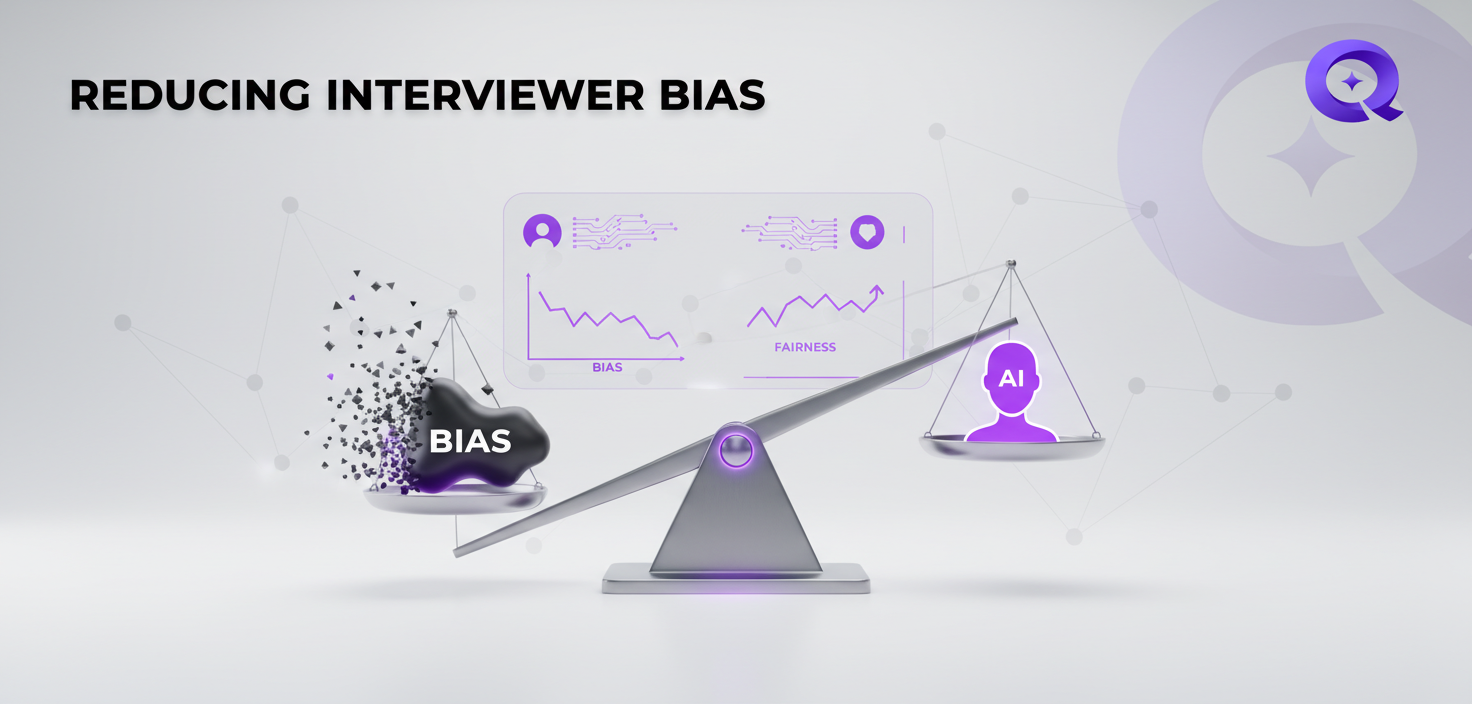
Interviewer bias is one of the most persistent challenges in qualitative research. AI moderation offers new tools to address it.
Types of Interviewer Bias
Confirmation Bias
Interviewers unconsciously seek responses that confirm existing hypotheses.
Social Desirability Bias
Participants give answers they think the interviewer wants to hear.
Leading Questions
Subtle word choices influence participant responses.
Inconsistent Probing
Some participants get more follow-up questions than others based on interviewer interest or energy.
Affinity Bias
Interviewers build more rapport with participants similar to themselves.
How AI Moderation Addresses Bias
Standardized Question Delivery
Every participant receives identical questions with identical wording. No variation based on:
- Interviewer mood or fatigue
- Time of day
- Participant characteristics
- Prior interview responses
Consistent Probing Logic
AI follows predetermined rules for follow-ups:
- Same depth of probing for all participants
- No unconscious "going easier" on some
- Identical clarification prompts
Reduced Social Pressure
Many participants feel less judged by AI:
- No fear of disappointing the interviewer
- Reduced social desirability effects
- More honest responses on sensitive topics
Elimination of Non-Verbal Influence
AI cannot:
- Nod approvingly at certain answers
- Show surprise or disappointment
- Signal which answers are "correct"
Practical Implementation
Step 1: Neutral Question Design
Biased: "Don't you think the new feature is helpful?"
Neutral: "How would you describe your experience with the new feature?"
Step 2: Balanced Response Options
When using scales or categories, ensure balance:
- Equal positive and negative options
- Neutral midpoint when appropriate
- No loaded language
Step 3: Randomize Question Order
Where logical sequence isn't essential, randomize to prevent order effects.
Step 4: Blind Analysis
Analyze responses without knowing participant demographics initially to prevent bias in interpretation.
Limitations to Consider
AI moderation reduces but doesn't eliminate all bias:
- Question design bias still requires human judgment
- Selection bias in recruitment persists
- Interpretation bias in analysis remains
- AI training bias may exist in underlying models
Combining Approaches
The strongest approach often combines AI and human methods:
- Use AI for standardized data collection
- Have multiple human analysts review findings
- Cross-check AI interpretations with human judgment
- Iterate on question design based on pilot data
Measuring Improvement
Track these metrics to assess bias reduction:
- Response distribution across demographic groups
- Average response length by participant type
- Sentiment patterns by interviewer (for comparison studies)
- Follow-up probe frequency
Qualz.ai helps research teams implement bias-reducing practices through standardized AI interview protocols with built-in consistency checks.