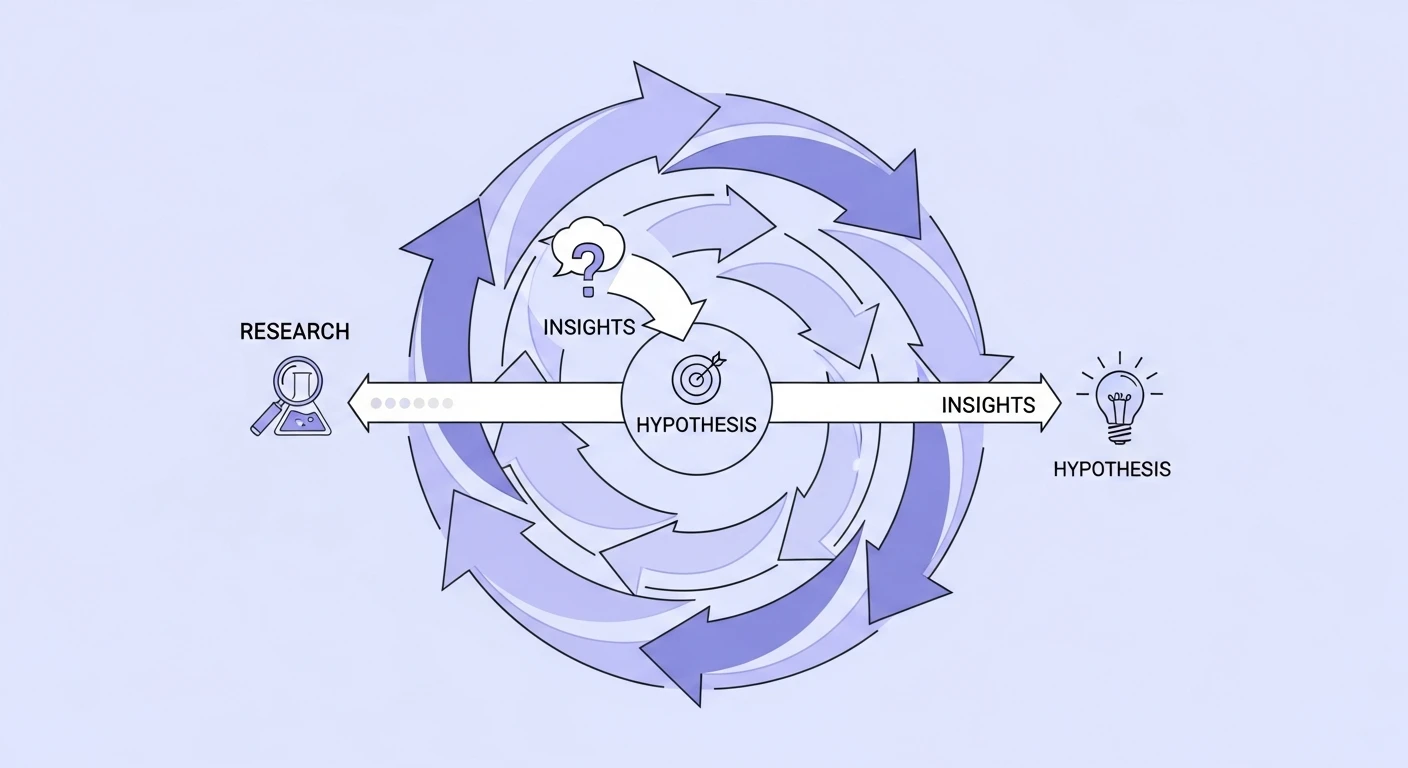
If you run a centralized insight function at a large consumer company, you already know the math does not work. You have a small team. You have dozens of business units, brand teams, and regional markets that all need research. You have a backlog that grows faster than you can clear it. And every quarter, someone asks why the insight team is a bottleneck.
The centralization trend is real and accelerating. Companies like Perrigo, Unilever, and P&G have been consolidating research operations for years -- moving from fragmented, brand-level research teams to centralized insight functions that serve the entire organization. The logic is sound: centralization creates consistency, reduces duplication, builds institutional knowledge, and makes research spend more efficient.
But centralization also creates a capacity problem that no amount of hiring solves. When you become the single point of research delivery for an organization with fifty brand teams across thirty markets, the volume of research requests outstrips your ability to conduct, analyze, and deliver insights using traditional methods. The answer is not more headcount. The answer is better infrastructure.
The Centralized Insight Function: What It Actually Looks Like
A centralized insight function typically sits within a corporate strategy, marketing, or innovation group. It serves as an internal research consultancy -- fielding requests from brand teams, product groups, regional marketing leads, and innovation teams, then designing and executing research that informs decisions across the business.
The model works well in theory. In practice, centralized teams face several structural challenges that compound as the organization scales:
Demand always exceeds capacity. When research is "free" to the business units (funded centrally rather than charged back), demand is effectively unlimited. Every brand manager has questions. Every product launch needs consumer validation. Every market entry requires local insight. The insight team becomes a service desk with a permanent queue.
Consistency is hard across geographies. A global consumer company needs research conducted in multiple languages, across different cultural contexts, with consistent methodological standards. Running qualitative research in Brazil, Germany, Japan, and the United States with the same rigor and comparability is an enormous operational challenge. The complexities of cross-cultural qualitative research multiply when you are trying to synthesize findings across dozens of markets simultaneously.
Knowledge gets trapped in projects. Every research project generates insight, but without systematic knowledge management, those insights live in slide decks on SharePoint drives, in the heads of individual researchers, or in project folders that nobody revisits. Six months later, a different brand team commissions research that covers substantially the same ground because nobody knew the prior work existed. Building a research repository that teams actually use is the difference between an insight function that accumulates organizational knowledge and one that repeatedly reinvents the wheel.
Self-serve is the promise but not the reality. Most centralized insight teams aspire to enable self-serve research -- giving brand teams and product managers the tools and templates to answer their own questions without requiring the central team's involvement for every request. But traditional qualitative research is not self-serve. It requires trained moderators, careful discussion guide design, skilled analysis, and methodological judgment. You cannot hand a brand manager a Zoom link and expect rigorous qualitative insight.
Why Traditional Approaches Hit a Ceiling
The traditional model for centralized insight delivery relies on a combination of internal researchers, external agency partners, and standardized research frameworks. Each has limitations at scale.
Internal researchers are expensive, scarce, and slow to hire. A senior qualitative researcher with consumer goods experience and multi-language capability commands significant compensation. Even if budget were unlimited, the talent pool is finite. And each researcher can only conduct so many interviews, analyze so many transcripts, and deliver so many reports per quarter.
Agency partners provide surge capacity but introduce coordination overhead, inconsistent quality, and significant cost. When you are running qualitative research across twenty markets through five different agency partners, maintaining methodological consistency becomes a full-time management job. The cost per insight is high, the turnaround is slow, and the institutional knowledge stays with the agency rather than building within your organization. As the research industry is discovering, the agency model itself is under pressure from teams that want faster, more integrated research delivery.
Standardized frameworks (templated discussion guides, fixed analytical lenses, predetermined output formats) help with consistency but sacrifice depth. When every qualitative project follows the same template, you get comparable outputs but miss the contextual nuance that makes qualitative research valuable in the first place.
The ceiling is structural: the centralized insight function is trying to deliver a service that is inherently artisanal (deep qualitative understanding of human behavior) at industrial scale (dozens of business units, hundreds of research questions, global markets). Something has to give.
The AI Infrastructure Layer for Centralized Research
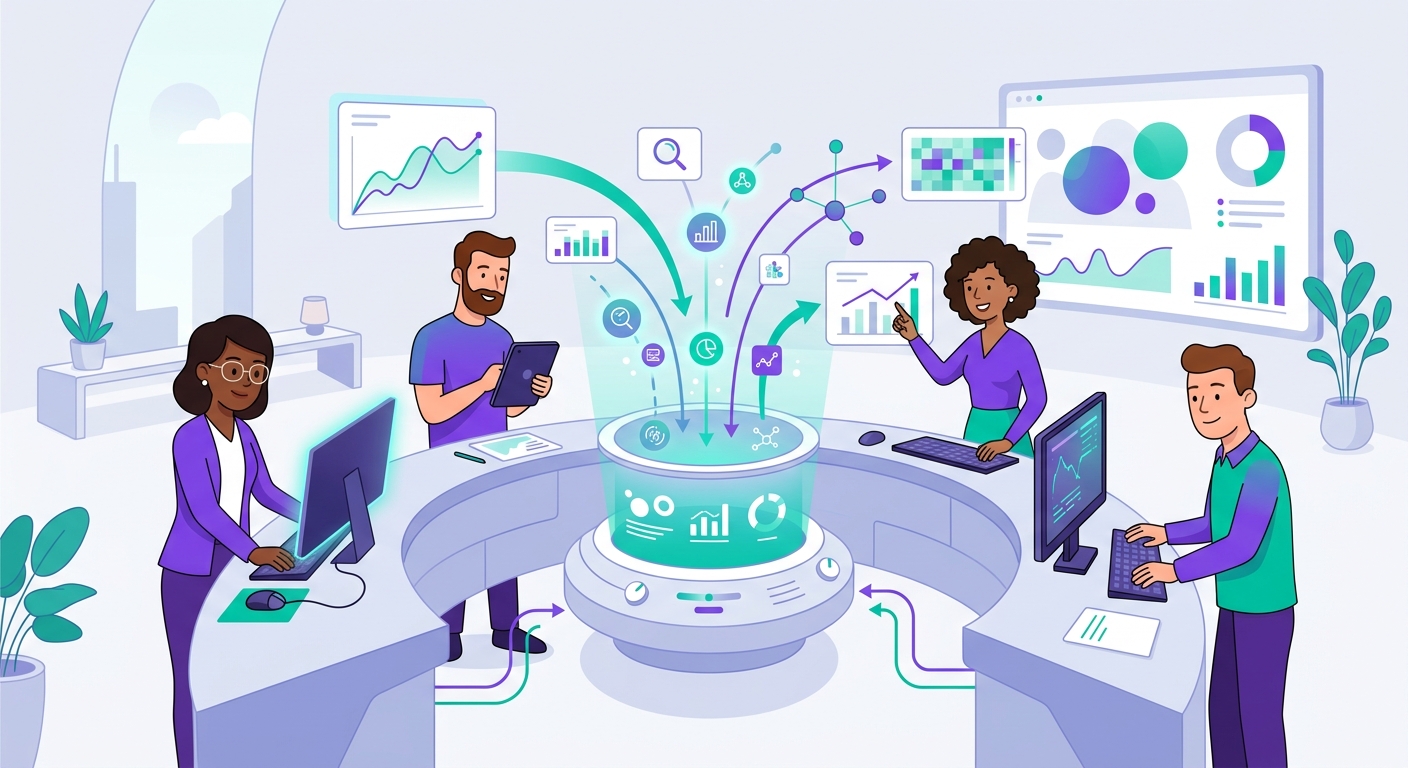
This is where AI-powered qualitative research tools change the equation -- not by replacing researchers but by creating an infrastructure layer that multiplies the capacity of a centralized team.
Scalable data collection through AI-moderated interviews. The single biggest bottleneck in qualitative research is the interview itself. A human moderator can conduct four to six in-depth interviews per day before fatigue degrades quality. AI-moderated interviews remove this constraint entirely. The fundamentals of AI-moderated interviews are now well-established: AI can conduct structured qualitative conversations that probe, follow up, and adapt based on participant responses -- running dozens or hundreds of interviews simultaneously across time zones and languages.
For a centralized insight function, this means a single researcher can design a study, deploy it across fifteen markets in local languages, and have completed interviews from hundreds of participants within days rather than months. The researcher's expertise shifts from conducting interviews to designing research and interpreting results -- a much higher leverage use of scarce talent.
Consistent analysis at scale. When you have two hundred interview transcripts from twelve markets, manual analysis is not just slow -- it is practically impossible to do with genuine rigor. Human analysts reading through transcripts inevitably weight recent interviews more heavily, pattern-match based on expectations, and lose track of contradictory evidence across a large corpus. AI-powered qualitative analysis processes the entire dataset with consistent attention, identifying themes, contradictions, and patterns that a human analyst working through transcripts sequentially would miss.
This is particularly powerful for centralized functions because it enables genuine cross-market synthesis. Instead of getting separate reports from each market and trying to stitch together a global view, AI analysis can process all markets simultaneously and surface both universal themes and market-specific divergences.
Multi-language support without multi-language teams. Global consumer companies need research conducted in local languages. Participants express themselves more authentically in their native language, and cultural nuance is lost in translation. Traditional approaches require either local-language moderators in each market or simultaneous translation, both of which are expensive and introduce quality variation. AI-moderated interviews can be conducted natively in dozens of languages with consistent probing quality, and analysis can synthesize across languages without the lossy step of human translation.
Self-serve that actually works. The self-serve aspiration of centralized insight functions finally becomes realistic when the research tool itself embeds methodological rigor. A brand manager who needs to understand consumer response to a new packaging concept does not need to become a qualitative researcher -- they need a tool that guides them through designing an effective interview study, conducts the interviews with appropriate probing, and delivers analyzed results. The central insight team's role shifts from executing every study to setting standards, training on the platform, quality-assuring outputs, and focusing their direct involvement on the highest-stakes strategic research.
Integration with Knowledge Management
For centralized insight functions, the value of individual research projects is a fraction of the value of accumulated organizational knowledge. Every interview, every finding, every consumer insight should feed into a growing knowledge base that makes the entire organization smarter over time.
This is where most insight functions fall short. Research outputs live in project folders. Findings are presented once and archived. When a new brand manager joins and asks "what do we know about consumer attitudes toward sustainability in our category?", the answer requires an experienced researcher to recall which projects touched that topic and manually assemble relevant findings.
AI-powered qualitative platforms change this by treating every interview and analysis as structured data that feeds a searchable qualitative research repository. When research data is structured rather than locked in PDFs and slide decks, the centralized insight function becomes a genuine knowledge asset -- one where the answer to "what do we already know about this?" is a query, not a quest.
This also addresses the duplication problem directly. Before commissioning new research, brand teams can search existing insights to see whether the question has already been answered. The central team can identify gaps in organizational knowledge and proactively commission research that fills them, rather than reactively responding to whatever request comes in next.
Making the Transition: Practical Considerations
If you are leading a centralized insight function and evaluating AI qualitative research tools, the considerations that matter most are not feature checklists. They are operational fit.
Start with the backlog, not a pilot. The worst way to evaluate AI research tools is a carefully controlled pilot study with no time pressure. The best way is to throw a real backlog item at it -- something that has been sitting in the queue because the team does not have capacity. You will learn more about operational fit from processing a real request under real constraints than from a side-by-side methodology comparison.
Measure researcher leverage, not replacement. The metric that matters is not "can AI do what our researchers do?" It is "can each researcher now serve twice as many business units without quality degradation?" The hidden ROI of structured qualitative data shows up in throughput, not in headcount reduction.
Prioritize integration over features. A centralized insight function lives or dies by how well it connects to the rest of the organization. The qualitative platform needs to integrate with your knowledge management system, your reporting workflows, and your stakeholder communication channels. A brilliant standalone tool that does not connect to the systems your business units already use will not get adopted.
Design for governance from day one. Centralized functions exist partly to maintain quality standards. Your AI research platform needs to support governance -- approved discussion guide templates, analytical frameworks that align with your methodological standards, PII handling that meets your compliance requirements, and audit trails that let the central team quality-assure outputs from self-serve users.
Think global from the start. If you operate across multiple markets, evaluate multi-language capability as a core requirement, not a nice-to-have. The cost savings from eliminating market-by-market agency relationships for routine qualitative studies alone can justify the platform investment.
The Centralized Function of the Future
The centralized insight function that thrives in 2026 and beyond will look fundamentally different from the one that existed five years ago. It will be smaller in headcount but larger in impact. Its researchers will spend less time conducting interviews and coding transcripts and more time designing research programs, interpreting findings in strategic context, and consulting with business units on how to act on insights.
AI infrastructure does not diminish the role of the insight professional. It elevates it -- from research execution to research leadership. The centralized team becomes the architects of the organization's qualitative intelligence capability rather than its manual operators.
The companies that make this transition will have a structural advantage: faster insight delivery, more consistent quality, lower per-study cost, cumulative organizational knowledge, and research capacity that scales with the business rather than with headcount.
If you are building or optimizing a centralized insight function and want to see how AI-powered qualitative research fits into your operation, [book an information session with our team](https://app.reclaim.ai/m/qualz-info-session/qualz-information-session). We work with insight leaders at global consumer companies to design research infrastructure that scales.