The Fragmentation Problem in Qualitative Analysis
Thematic coding is the workhorse of qualitative UX research. You take an interview transcript, break it into segments, assign codes, and cluster those codes into themes. It is systematic, defensible, and scales well -- especially with AI-powered qualitative analysis handling the initial coding pass.
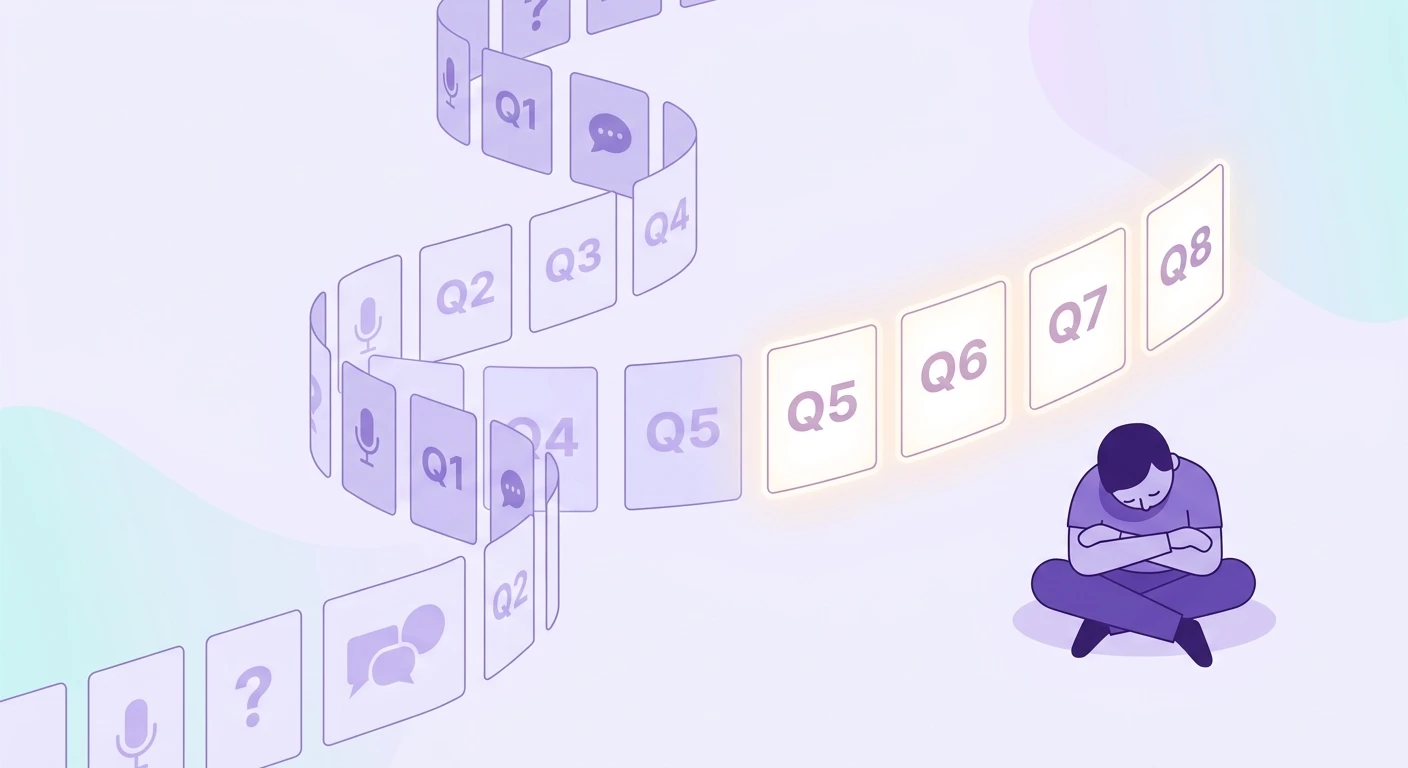
But thematic coding has a structural limitation that most research teams never discuss: it fragments the participant's story.
When you code an interview, you extract segments from their narrative context and group them with similar segments from other participants. The result is a thematic map -- a useful abstraction, but one that has destroyed the very thing that made the original data rich: the story.
Consider a participant describing why they switched from a competitor product. In thematic coding, that account gets split across multiple codes: "frustration with onboarding" goes to one theme, "price sensitivity" to another, "recommendation from a colleague" to a third. What gets lost is the narrative logic that connects them -- the participant tried the competitor because a colleague recommended it, tolerated the bad onboarding because they trusted the recommendation, but the moment pricing increased, the stored frustration from onboarding combined with the price shock to trigger the switch.
That causal chain -- the actual decision architecture -- disappears when you fragment the narrative into coded segments. And it is precisely the kind of insight that changes product strategy.
What Narrative Analysis Actually Is
Narrative analysis is a family of qualitative methods that treats the story as the primary unit of analysis rather than the coded segment. Instead of asking "what themes appear across these interviews?" it asks "what stories are participants telling, and what do those stories reveal about how they experience and make sense of their world?"
This is not storytelling for its own sake. Narrative analysis rests on a foundational insight from the social sciences: humans are narrative creatures. We do not experience our lives as collections of thematic fragments. We experience them as stories with characters, settings, conflicts, turning points, and resolutions. When participants talk about their experience with a product, they are not reciting a list of features and frustrations -- they are constructing a narrative that makes sense of their experience.
The structure of that narrative -- what they emphasize, what they minimize, where they place themselves as protagonist or victim or expert -- reveals things that thematic coding cannot surface:
Causal models. How does the participant believe things connect? What do they think caused what? These causal beliefs drive behavior far more than isolated attitudes. A participant who narrates their workflow as "I have to do X because the system forces me to" has a fundamentally different relationship with the product than one who narrates it as "I choose to do X because it works best for me" -- even if both perform the same actions.
Identity work. Participants position themselves within their narratives. A power user who narrates their experience as "I figured out how to make it work despite the tool" is doing identity work -- positioning themselves as competent and the tool as inadequate. That identity investment means they will resist switching to a simpler tool that threatens their expert identity, something that detecting contradictions in interviews can sometimes surface but narrative analysis makes explicit.
Temporal logic. Stories have sequence. The order in which a participant narrates events reveals their mental model of causation and importance. If they consistently describe the pricing page before discussing features, price is the frame through which they evaluate everything else. Thematic coding loses this temporal signal because it extracts segments from their sequential context.
Emotional architecture. Where does the narrative intensify? Where does the participant become animated, frustrated, proud, or dismissive? These emotional inflection points mark the moments that matter most to the participant -- the peaks and valleys that shape their overall evaluation of the experience, as experience sampling research has shown from a different angle.
When Narrative Analysis Outperforms Thematic Coding
Narrative analysis is not a replacement for thematic coding. It is a complement that excels in specific research contexts.
Switching and adoption stories. When you need to understand why users adopt, switch, or churn, narrative analysis is superior because these are inherently sequential, causal processes. The participant's story of how they went from awareness to evaluation to decision to adoption (or abandonment) contains the decision architecture that Jobs-to-Be-Done interviews aim to uncover but often fragment through premature coding.
Workflow and process research. When studying how people work, narrative analysis preserves the procedural logic that thematic coding disrupts. A participant narrating their daily workflow reveals not just what they do but why they do it in that order, what they are anticipating, and where they feel friction versus flow.
Cultural and organizational research. When studying how teams or organizations adopt technology, narrative analysis surfaces the shared stories that groups tell about change. "We tried that before and it did not work" is not a data point -- it is a narrative that shapes organizational behavior. Understanding these narratives is essential for product teams selling into enterprises.
Experience over time. For longitudinal research, narrative analysis is particularly powerful because it preserves how the participant's story changes across time points. Their narrative at month one versus month six reveals not just what changed but how they make sense of the change.
Practical Narrative Analysis for UX Teams
Here is a lightweight narrative analysis approach that UX research teams can adopt without abandoning thematic coding.
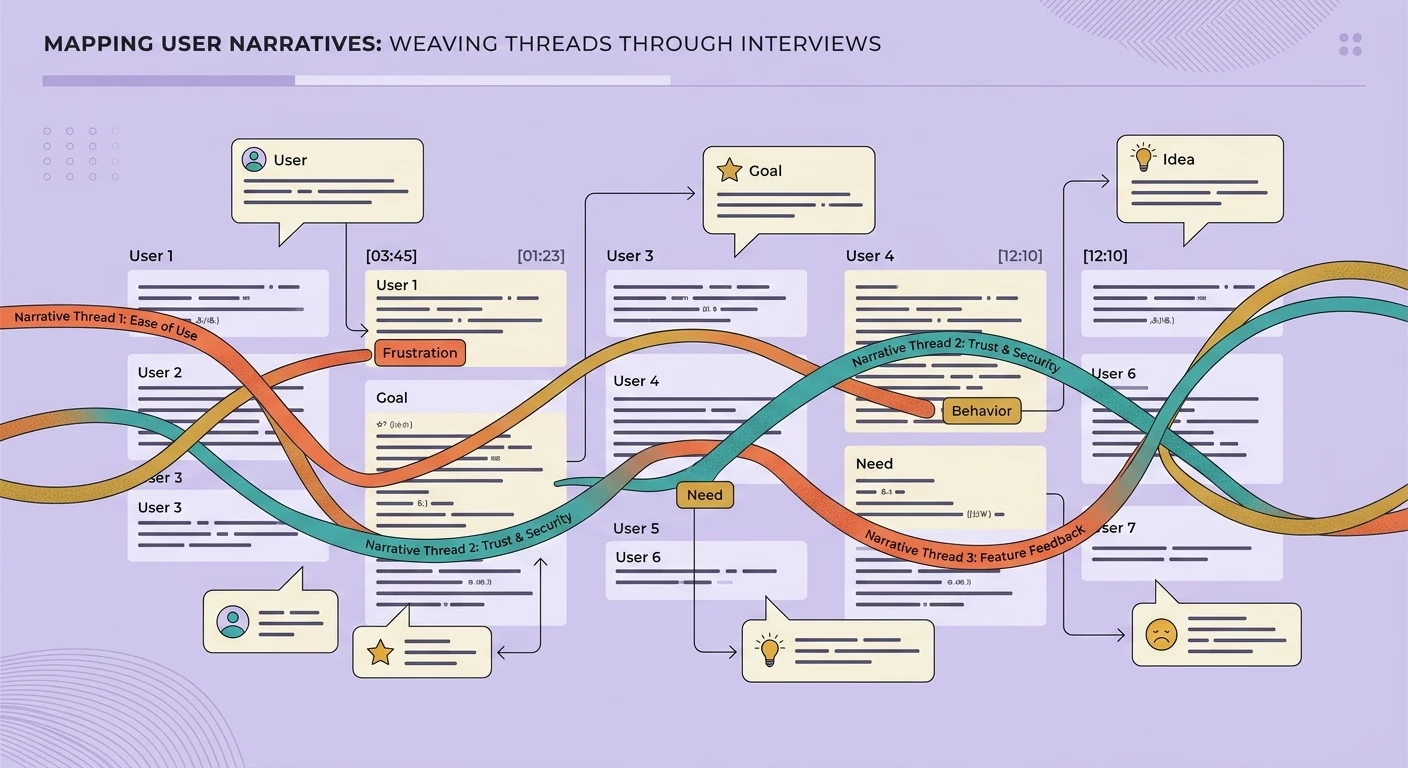
Step 1: Identify the core narratives. After conducting interviews, read each transcript holistically -- not looking for codes, but looking for stories. What is the participant's "big story" about their experience? Most interviews contain 2-4 distinct narratives embedded within the conversation.
Step 2: Map narrative structure. For each core narrative, identify the key structural elements: the setting (context), the complication (problem or trigger), the actions taken, the resolution (or lack thereof), and the evaluation (what the participant thinks it all means). This structural mapping is what separates narrative analysis from simply "reading the transcript."
Step 3: Compare narrative types across participants. Instead of comparing codes across participants, compare story types. Do switching stories follow a common pattern? Are there distinct narrative archetypes -- the frustrated expert, the reluctant adopter, the enthusiastic evangelist? These archetypes often map to user segments more meaningfully than demographic or behavioral clusters.
Step 4: Extract the implications that thematic coding missed. The payoff of narrative analysis is insights that live in the connections between themes rather than within them. The causal chains, the identity dynamics, the temporal logic -- these are the strategic insights that change product direction.
AI tools can accelerate this process. Platforms like Qualz.ai can handle the initial thematic coding while researchers focus on the narrative layer -- reading holistically, mapping story structures, and identifying the patterns that emerge from keeping participants' accounts whole rather than fragmenting them.
The Integration Point
The strongest research practice uses both methods. Thematic coding gives you breadth -- patterns across your participant pool. Narrative analysis gives you depth -- the causal and emotional logic that explains why those patterns exist.
When you present findings, lead with the narrative. Stakeholders remember stories. They do not remember theme clusters. A well-told switching narrative -- with the causal chain intact, the emotional inflection points marked, the identity dynamics visible -- lands in a product review meeting in a way that a thematic map never will.
Then back the narrative with the thematic data. "This is not one person's story -- we saw this pattern across fourteen of twenty participants, and here are the thematic clusters that confirm it."
That combination -- narrative for persuasion, thematic for validation -- is how research findings actually change decisions. And in an era where the volume of qualitative data is growing faster than teams can process it, mastering both analytical lenses is not optional. It is the difference between research that sits in a repository and research that ships in the product.