When you analyze qualitative data, you're making choices. Thematic analysis surfaces different insights than narrative analysis. A jobs-to-be-done lens reveals different patterns than a customer journey lens.
Most researchers pick one approach based on their research questions and theoretical commitments. That's methodologically sound—but it means potentially missing insights that other lenses would reveal.
What if you could apply multiple analytical lenses simultaneously?
That's the premise of multi-lens analysis, and it's changing how researchers extract value from qualitative data.
The Problem with Single-Lens Analysis
Traditional qualitative analysis involves choosing an analytical framework:
- Thematic analysis for identifying patterns and themes
- Grounded theory for building theory from data
- Narrative analysis for understanding story structures
- Framework analysis for applying existing theoretical frameworks
- Discourse analysis for examining language and power
Each lens illuminates certain aspects of your data while leaving others in shadow. A researcher using thematic analysis might miss the narrative arcs that give themes meaning. A researcher using jobs-to-be-done might overlook the emotional journey underlying task completion.
This isn't a flaw—it's how analysis works. But it means your choice of lens determines what you can see.
What Multi-Lens Analysis Offers
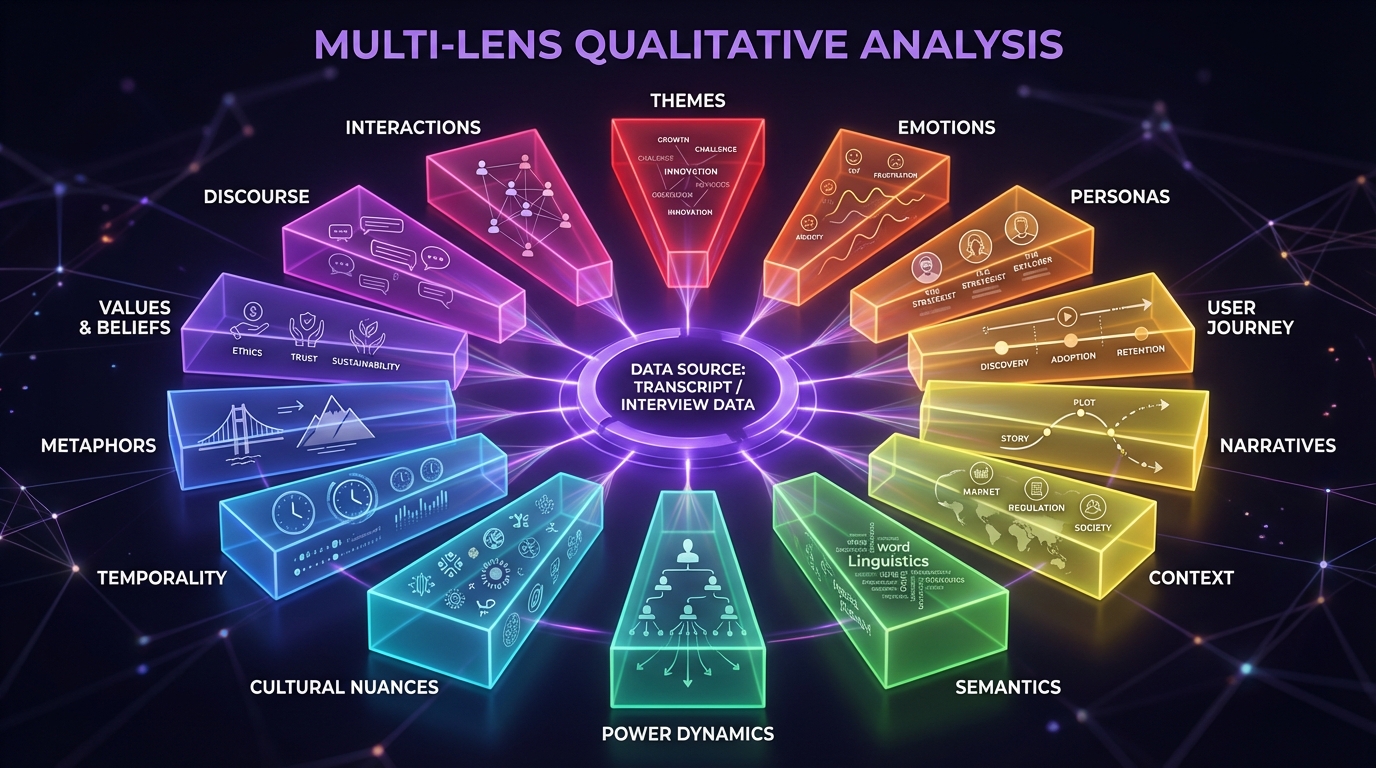
Multi-lens analysis applies multiple analytical frameworks to your data simultaneously. Instead of choosing between thematic analysis and sentiment analysis, you get both—plus a dozen more perspectives.
The 14 Lenses
Qualz.ai's multi-lens analysis includes:
1. Thematic Analysis
Identifies recurring patterns and themes across responses.
*Reveals*: What topics emerge consistently? What are participants talking about?
2. Open Coding
Generates codes directly from data without predetermined categories.
*Reveals*: What concepts are present in the data itself?
3. Sentiment Analysis
Maps emotional tone across and within responses.
*Reveals*: How do participants feel? Where does sentiment shift?
4. Emotion Spectrum
Identifies specific emotions beyond positive/negative sentiment.
*Reveals*: What specific emotions (frustration, hope, confusion) are present?
5. Jobs-to-be-Done
Surfaces the tasks participants are trying to accomplish.
*Reveals*: What are people hiring your product/service to do?
6. Customer Journey
Maps experiences across touchpoints and time.
*Reveals*: Where are the moments of truth? Where does experience break down?
7. Pain Points
Identifies specific frustrations and obstacles.
*Reveals*: What's getting in participants' way?
8. Narrative Arc
Analyzes story structure in participant accounts.
*Reveals*: How do participants frame their experiences as stories?
9. Persona Patterns
Groups participants by behavioral and attitudinal similarities.
*Reveals*: What distinct user types exist in your data?
10. Stakeholder Equity
Identifies whose voices and interests are represented.
*Reveals*: Whose perspective dominates? Who's missing?
11. Discourse Analysis
Examines language choices and implicit assumptions.
*Reveals*: What do word choices reveal about underlying beliefs?
12. Theory of Change
Identifies causal reasoning in participant accounts.
*Reveals*: What do participants believe causes outcomes?
13. Saturation and Coverage
Assesses comprehensiveness of data collection.
*Reveals*: Have you heard enough? What gaps remain?
14. Reflexivity Tracker
Identifies potential researcher influence on findings.
*Reveals*: Where might researcher assumptions be shaping interpretation?
How It Works in Practice
Let's trace how multi-lens analysis handles a single interview excerpt:
Participant quote: "I spent three hours trying to figure out the export function. Eventually I just took screenshots and sent those to my team. It was embarrassing—I'm supposed to be the expert, but I couldn't even generate a simple report."
Thematic Analysis: Codes this under "product usability" and "workarounds"
Sentiment Analysis: Identifies negative sentiment, frustration
Emotion Spectrum: Specifically tags "embarrassment" and "frustration"
Jobs-to-be-Done: "Share analysis with team" is the job; product failed to support it
Pain Points: "Export function difficult to use," "time wasted," "professional embarrassment"
Narrative Arc: This is a "failure story" with rising action (attempts) and falling action (workaround)
Persona Pattern: Contributes to "power user frustrated by limitations" persona
Each lens extracts different value from the same data. Combined, they create a multi-dimensional understanding that no single lens could provide.
The Value of Multiple Perspectives
Completeness
No analytical framework captures everything. Multi-lens analysis ensures insights don't fall between methodological cracks.
Triangulation
When multiple lenses point to the same insight, confidence increases. When lenses disagree, you've found something worth investigating.
Speed
Running 14 analyses manually would take months. AI-assisted multi-lens analysis completes in minutes, giving you comprehensive analysis without comprehensive timelines.
Discovery
Lenses you wouldn't have chosen often surface unexpected insights. The narrative arc analysis might reveal patterns you'd never have looked for using thematic analysis alone.
Interpreting Multi-Lens Output
Multi-lens analysis generates substantial output. Here's how to work with it effectively:
Start with Research Questions
Your research questions determine which lenses deserve most attention. If you're trying to improve usability, pain points and journey mapping take priority. If you're building personas, persona patterns and jobs-to-be-done matter most.
Look for Convergence
Where multiple lenses point to the same insight, you've found something robust. If thematic analysis, sentiment analysis, and pain points all highlight "onboarding confusion," that's a high-confidence finding.
Explore Divergence
When lenses suggest different interpretations, dig deeper. Maybe sentiment is positive while pain points are numerous—participants like your product despite frustrations. That's valuable nuance.
Follow Threads
Use one lens to identify a theme, then explore how other lenses illuminate it. Thematic analysis finds "trust concerns." What does sentiment analysis show about trust-related responses? What jobs are participants trying to do when trust becomes relevant?
Synthesize, Don't Stack
The goal isn't to report every lens's findings separately. It's to synthesize insights into coherent findings that draw from multiple analytical perspectives.
When Multi-Lens Analysis Works Best
Large Datasets
With 5 interviews, manual single-lens analysis is feasible. With 50 interviews, multi-lens analysis becomes essential for thorough analysis in reasonable time.
Complex Topics
Simple, focused topics might not need multiple perspectives. Complex organizational or experiential topics benefit from the dimensionality multi-lens analysis provides.
Exploratory Research
When you're not sure what you're looking for, multiple lenses maximize discovery potential.
Diverse Stakeholders
Different stakeholders care about different aspects of findings. Multi-lens analysis provides material for various audiences: executives want themes, designers want pain points, marketers want emotional language.
Limitations to Consider
Output Volume
Fourteen lenses generate substantial output. Without focus, you can drown in analysis rather than insights.
Human Judgment Still Required
Multi-lens analysis identifies patterns; humans must determine significance. AI can't tell you which findings matter for your specific context.
Not a Methodological Shortcut
Multi-lens analysis accelerates analysis but doesn't replace methodological thinking. You still need to understand what each lens offers and how to interpret output critically.
Getting Started
If you're new to multi-lens analysis:
- Run it on familiar data first—transcripts you've already analyzed manually. Compare multi-lens output to your existing analysis.
- Focus on 3-4 lenses initially. Understand those deeply before expanding attention.
- Use lenses that match your research questions. Not every lens will be relevant to every project.
- Synthesize across lenses rather than reporting each separately. Your stakeholders want insights, not a lens-by-lens tour.
- Iterate as you learn which lenses prove most valuable for your research context.
Ready to see your data from 14 perspectives? Upload transcripts to Qualz.ai and experience multi-lens analysis on your own qualitative data.