The Coverage Trap
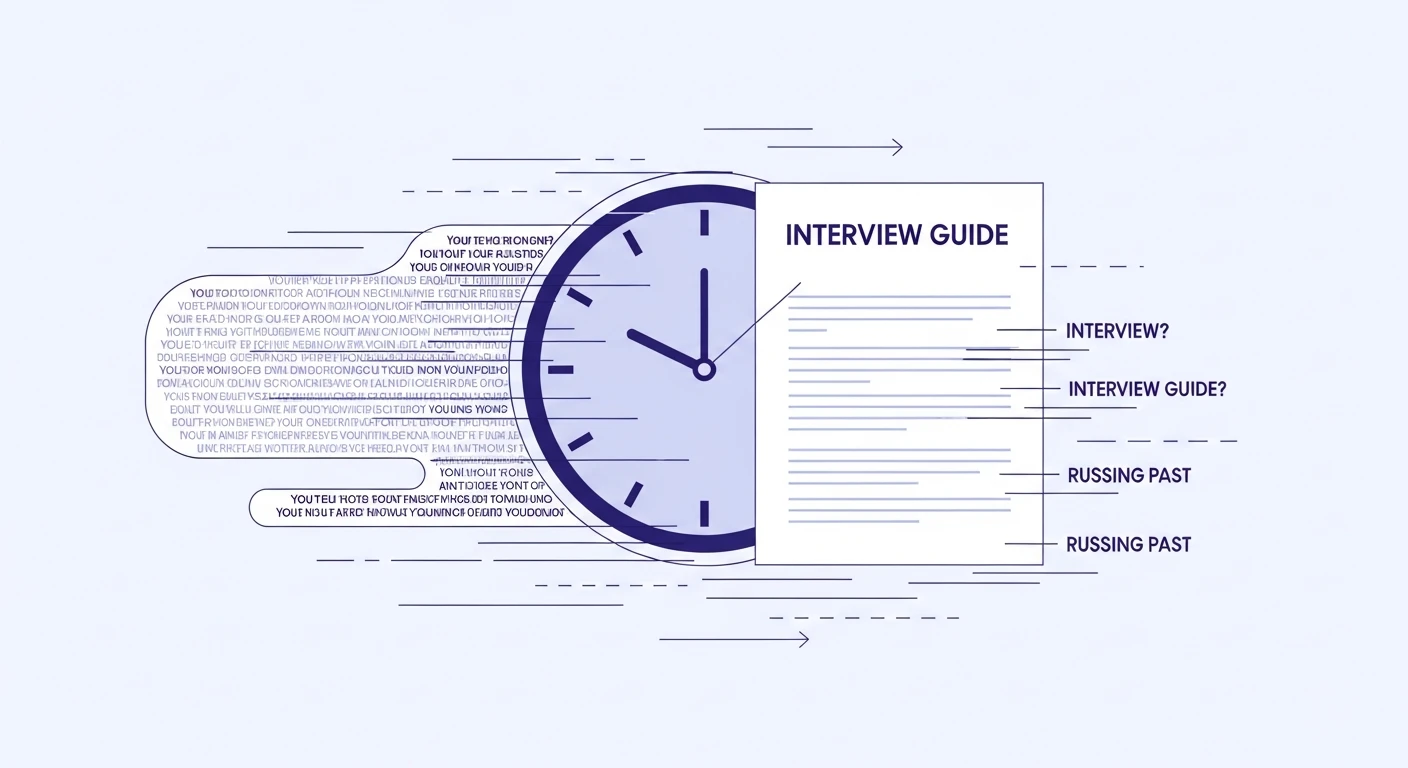
Research teams build comprehensive interview guides. They want to cover onboarding, feature discovery, workflow integration, pain points, competitive alternatives, and future needs — all in 45 minutes. The guide looks thorough on paper. In practice, it produces 20 shallow answers instead of 5 deep explorations.
This is the coverage trap: the belief that asking more questions produces more insight. It does not. It produces more data points at lower resolution. The richest qualitative findings come from sustained exploration of fewer topics, not superficial coverage of many.
Pacing is the skill that separates researchers who collect quotes from researchers who uncover genuine understanding.
Why Teams Default to Rushing
Three organizational forces push researchers toward over-packed guides:
Stakeholder question inflation. Product managers, designers, and executives all add "just one more question" to the guide. No single addition seems unreasonable. But collectively, they transform a focused exploration into an interrogation checklist. The resulting guide serves stakeholder anxiety ("we asked about my thing") rather than research quality.
Fear of silence. Inexperienced researchers treat pauses as failures. When a participant finishes answering, the impulse is to immediately ask the next question rather than letting the silence create space for deeper reflection. But silence in interviews is not dead air — it is processing time where participants access memories, feelings, and connections they would never reach if you immediately moved on.
Session time pressure. Forty-five minutes feels short. Researchers rush through early questions to "save time" for the important ones later. But rushing signals to participants that brief answers are expected, training them to give surface responses throughout the entire session.
The Pacing Paradox
Here is what experienced researchers learn: covering fewer questions produces more usable findings. A session that deeply explores three topics generates themes, nuances, and contradictions that drive genuine product insight. A session that briefly touches twelve topics generates confirmatory sound bites that tell you nothing you did not already suspect.
The math works like this: in a 45-minute session (with 5 minutes for intro and 5 for wrap-up), you have 35 minutes of core interview time. If you ask 15 questions, that is 2.3 minutes per topic — barely enough for a question, an answer, and one follow-up. If you ask 5 questions with full exploration, that is 7 minutes per topic — enough for the initial response, two to three probing follow-ups, a clarifying example, and space for the participant to revise or deepen their answer.
As work on probing techniques demonstrates, the real insights live in the third and fourth follow-up — layers that rushed sessions never reach.
Structural Pacing Techniques
The 3-5-3 framework. Design your guide with 3 warm-up questions (brief, rapport-building), 5 core exploration questions (where you spend 80% of your time), and 3 closing questions (reflection, anything missed, next steps). This structure makes pacing explicit: the core questions get the lion's share of time by design.
Time anchoring. Mark approximate time targets next to each section in your guide. Not to create rigidity, but to create awareness. When you hit the 20-minute mark and you are still on question 2 of your core block, you know you are investing deeply — and you can make a conscious choice about whether to continue or move on.
The permission pause. After a participant answers, wait 3 seconds before responding. Not awkwardly long — just enough to signal that you are genuinely considering their response. Often, participants fill this pause with additional context, qualifications, or examples that would never emerge if you immediately jumped to the next question.
Progressive depth markers. Build escalating depth into each core question: the initial question, a planned follow-up probe, an example request, and an emotion/impact exploration. You do not have to hit all four levels for every question — but having them planned means you know what depth looks like and can pursue it when a topic proves rich.
Recognizing Pacing Signals
Participant behavior tells you when you are pacing well versus rushing:
Signs of good pacing: Participants offer unsolicited examples. They contradict or revise earlier statements. They pause to think before answering. They connect topics to earlier parts of the conversation. They say things like "actually, let me think about that more" or "that reminds me of something else."
Signs of rushing: Answers are consistently under 30 seconds. Participants mirror your question language in their responses (parroting rather than reflecting). They never ask clarifying questions. Every answer feels "complete" without follow-up — which usually means it is surface-level.
Teams focused on building research repositories that get used discover that depth-paced sessions produce dramatically more reusable insight than breadth-focused ones. A single deeply-explored topic generates findings that remain relevant across multiple product decisions.
Handling Stakeholder Pressure for Coverage
The most common objection to slow pacing: "But we need answers to all these questions." Three responses:
Split across sessions. If you have 15 essential questions, run three 45-minute sessions focused on five topics each, rather than one session that covers all fifteen poorly. The investment in additional sessions pays for itself in data quality.
Prioritize ruthlessly. Force stakeholders to rank their questions. The top five get full exploration. The rest get asked only if time permits — and everyone accepts in advance that they might not get answered. This creates accountability for question inflation.
Show the quality difference. Run one session at rushed pace and one at exploration pace. Compare the outputs side by side. The depth difference is immediately obvious — and it permanently changes how stakeholders think about guide length. The principles of eval-driven development apply here too: measure quality, not just coverage.
Building Pacing Into Your Practice
Pacing is not a technique you apply occasionally. It is a research disposition — a fundamental belief that depth matters more than breadth, that silence is productive, and that fewer well-explored questions produce better outcomes than comprehensive checklists.
The shift requires practice. Start by cutting your next interview guide in half. Remove every question that is not essential to your core research objective. Then use the freed time to follow what participants actually want to tell you about — which is often more valuable than what you planned to ask.
Your guide is a starting point, not a contract. The best interviews diverge from the plan because the researcher follows depth wherever it appears. That only happens when pacing creates space for surprise.