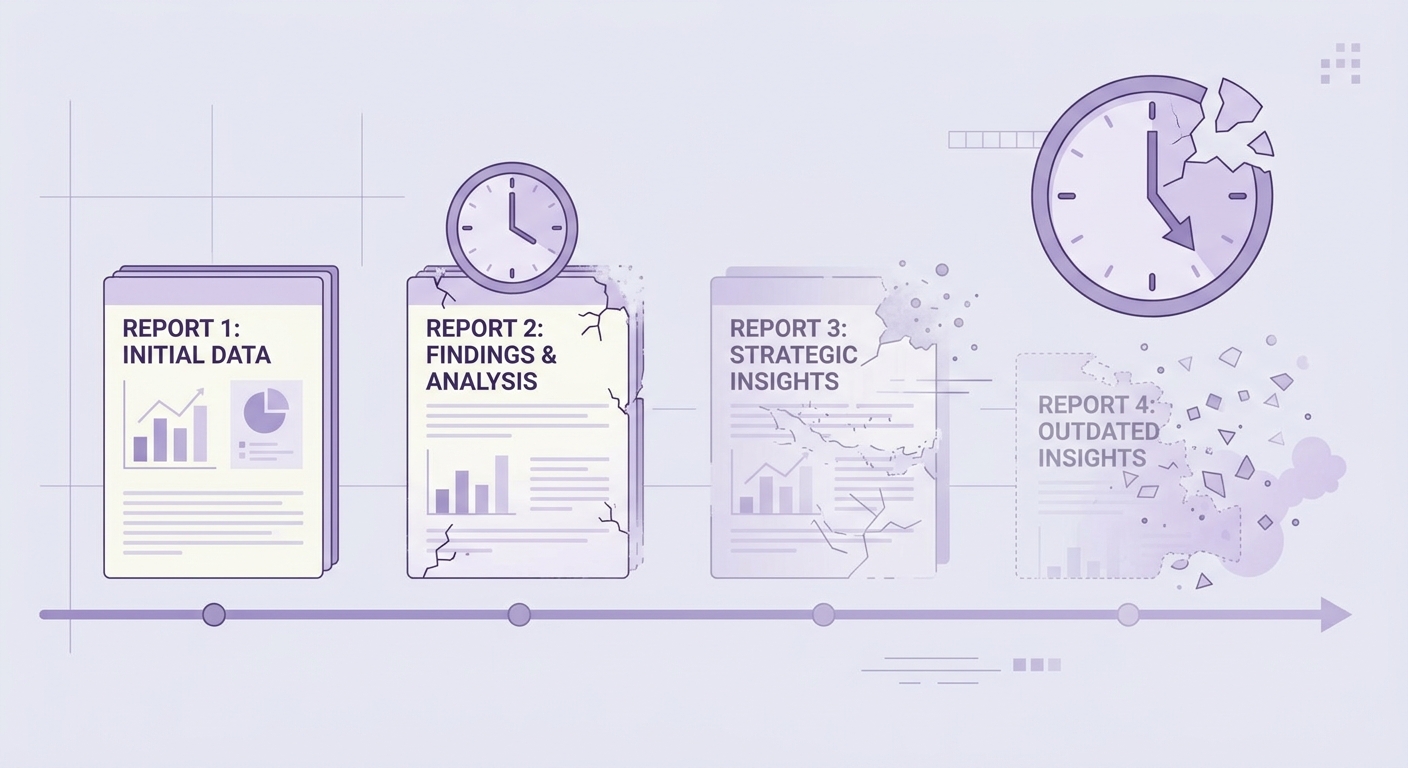
Every research team has a repository full of insights that nobody trusts. Not because the original research was flawed, but because nobody knows which findings still reflect reality and which have been silently invalidated by product changes, market shifts, or evolving user behaviors.
This is the insight decay problem. Research findings are not permanent truths -- they are time-bound observations with an expiration date that nobody stamps on them. And the faster your product and market move, the shorter that shelf life becomes.
For SaaS companies shipping weekly, a user research finding from six months ago might as well be from a different product. The onboarding flow has changed twice. The pricing model shifted. A competitor launched a feature that reset user expectations. Yet that six-month-old finding still sits in the research repository with the same authority as last week's discovery.
The Half-Life of Different Research Types
Not all research decays at the same rate. Understanding the decay curve for different insight types is essential for knowing when to trust existing findings and when to re-validate.
Usability findings have the shortest half-life -- roughly three to six months in a fast-moving SaaS product. Any finding tied to a specific UI, flow, or interaction pattern becomes suspect the moment that interface changes. A usability study on your onboarding flow from January is probably irrelevant if the flow was redesigned in March.
Behavioral patterns decay more slowly -- six to twelve months -- because they reflect habits and mental models rather than reactions to specific interfaces. How users organize their work, what triggers them to seek help, and when they switch between tools are relatively stable patterns. But even these shift as the competitive landscape evolves and new products reset user expectations.
Needs and motivations are the most durable -- one to two years -- because they are rooted in job-to-be-done fundamentals rather than product specifics. The reasons a product manager needs qualitative research have not changed much in five years. But the way they expect to conduct that research has changed dramatically as AI-powered research tools have reshaped the landscape.
Market and competitive insights are the most volatile -- three to six months at best. In the AI space, competitive dynamics shift monthly. A finding about what alternatives users considered is outdated almost as soon as it is published.
The problem is that most research repositories make no distinction between these categories. A usability finding from 2024 sits alongside a needs analysis from 2025 with no indication of relative confidence or freshness.
Why Traditional Repositories Fail
Research repositories were built on a library model: collect insights, tag them, make them searchable, and assume they accumulate value over time. This model works for stable knowledge domains. It fails catastrophically for product research in fast-moving markets.
The library model has three fatal assumptions:
Assumption one: insights are additive. More insights equal more knowledge. In reality, new insights frequently contradict or invalidate older ones. A repository that treats all findings as equally valid becomes a source of confusion rather than clarity. Product managers cherry-pick the findings that support their existing beliefs because the repository offers no way to distinguish current truth from historical artifact.
Assumption two: context is captured in tags. Repositories tag insights by theme, product area, and user segment. They rarely capture the conditions under which the finding was valid -- the product version, the competitive landscape, the user population characteristics. Without this context, it is impossible to assess whether a finding still applies.
Assumption three: someone will maintain it. The dream of the living repository requires continuous curation -- retiring stale findings, updating context, linking new evidence to old conclusions. In practice, research teams are too busy generating new insights to maintain old ones. The repository becomes a write-only database.
As teams working on building research repositories have learned, the architecture of the repository matters less than the maintenance model. A beautifully structured repository that nobody curates is worse than an ugly spreadsheet that gets updated weekly.
Designing for Decay
The solution is not to fight insight decay but to design for it. Every research finding should carry metadata that helps consumers assess its current reliability.
Confidence decay timestamps. When a finding is published, assign an estimated validity window based on its type. Usability findings get a six-month window. Behavioral patterns get twelve months. Needs analyses get eighteen months. After the window expires, the finding gets flagged as "needs revalidation" -- not deleted, but visually distinguished from current findings.
Invalidation triggers. Link findings to the product and market conditions under which they were generated. When the onboarding flow is redesigned, all findings tagged to that flow automatically get flagged for review. When a major competitor launches, competitive insights get flagged. This requires integration between your research repository and your product development process, but it converts a manual curation burden into an automated maintenance system.
Evidence chains. When new research validates or contradicts an existing finding, link them explicitly. A finding that has been independently validated three times over eighteen months is more trustworthy than one with a single evidence point, regardless of age. The repository should surface this evidence history.
The approach mirrors what AI governance frameworks have learned about model monitoring: you cannot assume that something that worked at deployment time continues to work. You need systematic mechanisms to detect drift and trigger revalidation.
The Revalidation Cadence
Designing for decay means building revalidation into the research operating rhythm. This is not about re-running every study on a schedule. It is about strategically checking whether key findings still hold.
The most efficient revalidation method is lightweight intercept studies or quick-pulse surveys that test the core claims of existing findings. If your last onboarding study found that users were confused by the workspace concept, a five-question intercept study can check whether that confusion persists after the UI update -- in days, not weeks.
Prioritize revalidation by decision impact. A stale finding that nobody references is harmless. A stale finding that the product team is using to justify a major feature investment is dangerous. Track which findings are being cited in product decisions and prioritize their revalidation.
The continuous discovery model naturally supports revalidation because the team is in constant contact with users. Weekly customer touchpoints serve double duty: generating new insights and stress-testing existing ones. When a finding from three months ago conflicts with what you are hearing this week, that is a revalidation signal.
Organizational Implications
The insight decay problem is ultimately an organizational challenge, not a tools problem. It requires a cultural shift from "we did the research" to "we are maintaining our understanding."
This means research teams need to allocate capacity for revalidation -- not as a nice-to-have when there is slack, but as a core function. A reasonable starting point is 20% of research capacity dedicated to revalidation activities. This sounds expensive until you consider the cost of product decisions made on stale evidence.
It also means changing how insights are communicated. Instead of presenting findings as definitive conclusions, present them with explicit validity conditions: "Based on the current onboarding flow and our mid-market user segment as of Q1 2026, users expect..." This framing invites re-examination rather than permanent acceptance.
For enterprises dealing with the hidden cost of unanalyzed data, insight decay compounds the problem. Not only do you have qualitative data that was never analyzed, but the data that was analyzed is steadily losing relevance. The combination means your actual pool of reliable, current customer intelligence is far smaller than your repository suggests.
The teams that manage insight decay well share a common trait: they treat their research repository as a living model of customer understanding, not a library of past studies. Models need updating. Libraries just need shelving. The difference determines whether your research practice accumulates compounding value or slowly decaying artifacts.