Healthcare organizations know patient experience matters. CMS ties reimbursement to patient satisfaction scores. Quality improvement requires understanding patient perspectives. And competitive differentiation increasingly hinges on experience.
But healthcare research comes wrapped in compliance requirements that make many organizations hesitate: HIPAA, IRB protocols, state privacy laws, and the inherent sensitivity of health information.
This guide explores how modern research platforms are making patient experience research more accessible while maintaining the compliance rigor healthcare demands.
Why Patient Research Is Different
Healthcare research isn't just regular research with extra paperwork. The nature of health information creates unique challenges:
Sensitivity of Data
Patient experiences often involve:
- Diagnosis and treatment details
- Mental health information
- Substance use
- Sexual health
- Genetic information
- Financial circumstances
This isn't just personal data—it's the most sensitive data people have.
Vulnerability of Participants
Patients may be:
- In active treatment and under stress
- Dependent on providers for ongoing care
- Experiencing cognitive effects of illness or medication
- Economically disadvantaged
These vulnerabilities require additional ethical safeguards beyond standard research protocols.
Regulatory Environment
Healthcare research operates under multiple overlapping frameworks:
- HIPAA (federal health information privacy)
- State privacy laws (often stricter than HIPAA)
- IRB requirements (for systematic research)
- CMS conditions of participation
- Joint Commission standards
Navigating this landscape requires expertise most organizations don't have in-house.
The Traditional Approach (And Its Problems)
Healthcare organizations typically approach patient research in one of three ways:
Option 1: Don't Do It
Many organizations rely entirely on standardized surveys (HCAHPS, Press Ganey) and skip qualitative research altogether. They get scores but not understanding.
Problem: You know you scored 3.2 on "communication with nurses" but have no idea what that means or how to improve.
Option 2: Outsource Everything
Hire specialized healthcare research consultants who manage IRB, recruitment, interviewing, and analysis.
Problem: Expensive ($50,000+ for a single study) and slow (months from initiation to findings).
Option 3: DIY with Consumer Tools
Use general-purpose survey or interview tools not designed for healthcare.
Problem: Compliance gaps, security concerns, and potential HIPAA violations.
None of these options serve healthcare organizations well. The first sacrifices insight. The second sacrifices budget and speed. The third sacrifices compliance and security.
A Better Approach: Purpose-Built Healthcare Research
Modern healthcare research platforms address these challenges through:
Compliance by Design
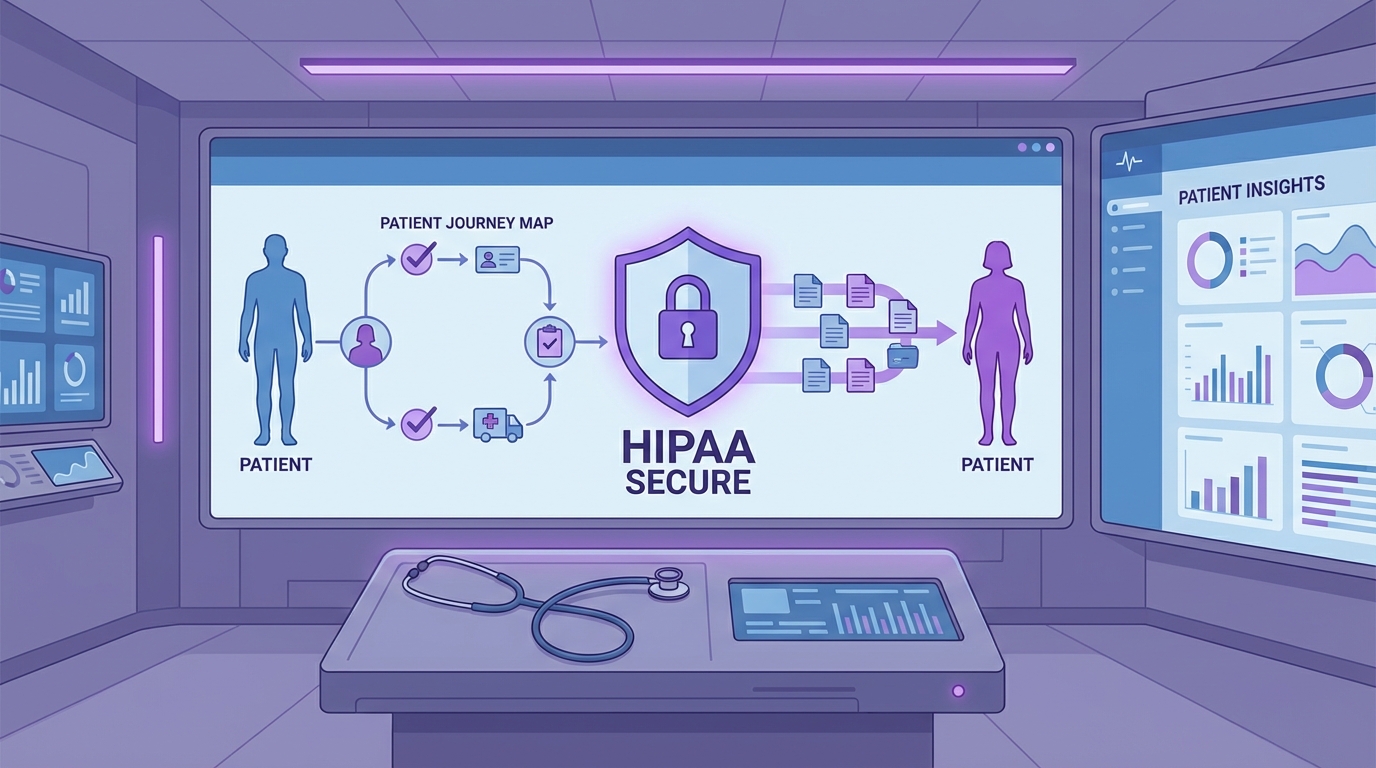
Instead of bolting compliance onto generic tools, platforms built for healthcare start with compliance requirements:
- Data handling meets healthcare security standards
- Consent workflows include healthcare-specific elements
- De-identification tools support HIPAA requirements
- Audit trails document everything for regulatory review
Appropriate AI Application
AI can enhance healthcare research while respecting its unique constraints:
Good applications:
- AI-assisted analysis of de-identified transcripts
- Automated theme identification across patient interviews
- Multi-language support for diverse patient populations
- Real-time transcription with speaker identification
Careful applications:
- AI-moderated interviews (require extra consent and transparency)
- Automated sentiment analysis (requires clinical validation)
- Predictive analytics (separate regulatory considerations)
Integration with Healthcare Workflows
Research tools designed for healthcare understand:
- EHR integration constraints
- Clinical staff time limitations
- Patient communication preferences
- Regulatory reporting requirements
Practical Implementation
Quality Improvement (QI) vs. Research
An important distinction in healthcare: formal research (generalizable knowledge) requires IRB review, while quality improvement (internal improvement) often doesn't.
Many patient experience projects fall under QI:
- Understanding why patients miss appointments
- Improving discharge communication
- Identifying care coordination gaps
- Testing new service delivery approaches
Check with your compliance team, but QI projects often have faster paths to implementation.
De-identification Strategies
HIPAA allows use of health information for research if properly de-identified. Two approaches:
Safe Harbor: Remove 18 specific identifiers (names, dates, locations, etc.)
Expert Determination: Statistician certifies re-identification risk is very small
For qualitative research, Safe Harbor is usually more practical. Modern platforms can help automate identifier removal from transcripts while preserving meaningful content.
Consent Best Practices
Healthcare research consent should include:
- Clear explanation of what data will be collected
- How data will be protected
- Whether AI tools will be used
- Who will have access to identifiable information
- How findings will be used and reported
- That care won't be affected by participation or non-participation
For AI-moderated interviews, additional disclosure:
- That the interviewer is AI, not human
- How AI processing works
- Data handling for AI systems
Recruitment Approaches
Patient recruitment requires sensitivity:
Do:
- Partner with clinical staff who have relationships with patients
- Offer multiple participation options (phone, video, asynchronous)
- Provide meaningful incentives
- Ensure accessibility (language, technology, disability)
Don't:
- Recruit during acute illness or immediately post-procedure
- Use clinical staff as recruiters in ways that could feel coercive
- Over-recruit from populations already heavily studied
- Exclude populations based on convenience
Case Example: Improving Post-Discharge Experience
A health system wanted to understand why patients frequently called back within 48 hours of discharge with questions that seemed addressed during discharge teaching.
Traditional approach would require:
- IRB submission and approval (8-12 weeks)
- Hiring research staff for interviews
- Patient recruitment over months
- Manual transcription and analysis
- Final report 6+ months from start
Using compliant AI research tools:
- QI determination (not formal research) from compliance
- De-identified interview deployment via patient portal
- 50 patient interviews collected over 2 weeks
- AI-assisted analysis identifying key themes
- Actionable findings within 30 days
Key finding: Patients understood discharge instructions in the hospital but forgot details by the time they got home. Solution: Follow-up automated check-in call 4 hours post-discharge with key reminders.
Choosing a Healthcare Research Platform
Evaluate platforms on:
Security and Compliance
- SOC 2 certification (or equivalent)
- BAA availability for HIPAA-covered entities
- Data residency options for state law compliance
- Encryption standards
- Access control granularity
Healthcare-Specific Features
- De-identification tools
- Consent management
- Audit logging
- Integration capabilities
- Clinical workflow compatibility
Practical Considerations
- Ease of use for non-researchers
- Support for diverse patient populations
- Scalability for varying project sizes
- Cost model that works for healthcare budgets
Support and Partnership
- Understanding of healthcare research context
- Responsiveness to compliance questions
- Willingness to complete vendor security assessments
Getting Started
If patient experience research feels overwhelming, start small:
- Identify a QI opportunity that doesn't require IRB
- Engage compliance early to understand requirements
- Pilot with a small patient group (15-20 participants)
- Use learnings to build organizational comfort
- Scale methodically as you develop expertise
The goal isn't to conduct perfect research on day one. It's to build organizational capability for understanding patient experience over time.
The Bigger Picture
Healthcare is moving from volume to value, from transactions to relationships, from standardized care to personalized experience. Understanding patient perspectives isn't a nice-to-have—it's essential infrastructure for this transformation.
Modern research platforms make that understanding accessible without the compliance complexity that has historically made patient research feel out of reach.
Ready to understand your patients better? Explore healthcare research solutions or request a demo to discuss your specific compliance requirements.