Qualitative research generates some of the most sensitive data imaginable. Interview transcripts contain personal stories, opinions, health information, and identifiable details that participants share in trust.
Under GDPR, this data triggers significant compliance obligations. Getting it wrong isn't just bad research ethics—it's potentially illegal.
This guide covers what qualitative researchers need to know about GDPR compliance, from consent to data handling to choosing compliant research platforms.
Why Qualitative Data Is High-Risk Under GDPR
GDPR distinguishes between personal data and "special category" data that requires additional protections. Qualitative research often involves both:
Personal data (any information relating to an identified person):
- Names and contact information
- Voice recordings
- Video recordings
- Demographic information
Special category data (requiring explicit consent and additional safeguards):
- Health information
- Political opinions
- Religious beliefs
- Sexual orientation
- Ethnic origin
A single interview transcript might contain all of these. That's why qualitative research requires careful GDPR planning from the start.
The Six Lawful Bases for Processing
GDPR requires a lawful basis for any data processing. For qualitative research, the most relevant bases are:
Consent (Article 6(1)(a))
The most common basis for research. Participants explicitly agree to data collection and processing.
Requirements for valid consent:
- Freely given (no pressure or imbalance of power)
- Specific (covers exactly what you'll do with data)
- Informed (participants understand the implications)
- Unambiguous (clear affirmative action, not pre-ticked boxes)
- Withdrawable (participants can revoke consent anytime)
Legitimate Interests (Article 6(1)(f))
Sometimes used for commercial research where consent isn't practical. Requires demonstrating that research interests don't override participant rights.
Legitimate interests requires:
- Clear documentation of the interest being pursued
- Necessity assessment (could you achieve this without the data?)
- Balancing test (do participant interests override yours?)
Public Interest (Article 6(1)(e))
Available for research conducted in the public interest, including some academic research. Often requires additional legal basis in member state law.
Consent Done Right
For most qualitative research, consent is the appropriate lawful basis. Here's how to get it right:
Before Data Collection
Provide clear information about:
- Who you are (organization, contact details)
- What data you'll collect
- Why you're collecting it
- How long you'll keep it
- Who might access it
- How participants can withdraw
- Their rights under GDPR
Obtain explicit consent for:
- Recording (audio, video, or both)
- Transcription (including whether AI tools will be used)
- Data storage (where and for how long)
- Analysis (including any AI-assisted analysis)
- Potential future uses (secondary analysis, data sharing)
During Data Collection
- Remind participants they can stop or skip questions
- Check understanding of consent at key moments
- Document consent (signed forms or recorded verbal consent)
After Data Collection
- Store consent records securely
- Make withdrawal easy (clear process, prompt action)
- Honor scope limitations (don't use data beyond consented purposes)
Data Minimization and Purpose Limitation
GDPR's data minimization principle requires collecting only what you need. For qualitative research, this creates tension with the exploratory nature of the method.
Practical applications:
Interview recordings: Record only what's necessary. If you only need audio, don't capture video.
Transcripts: Consider whether verbatim transcription is necessary, or whether summary transcripts would suffice.
Identifiers: Remove names and obvious identifiers from transcripts where possible. Use participant codes.
Demographics: Collect only demographics relevant to your research questions.
Purpose limitation means you can only use data for the purposes participants consented to. If you want to use interview data for a different study later, you generally need new consent.
Storage and Security
GDPR requires "appropriate technical and organizational measures" to protect personal data. For qualitative research:
Technical Measures
- Encryption: Data encrypted at rest and in transit
- Access controls: Only authorized researchers can access raw data
- Secure storage: EU-based or adequacy-decision countries
- Backup and recovery: Protected against accidental loss
- Audit logs: Track who accessed what and when
Organizational Measures
- Training: Researchers understand GDPR obligations
- Policies: Clear data handling procedures
- Agreements: Data processing agreements with any third parties
- Retention schedules: Clear timelines for deletion
- Incident response: Procedures for data breaches
Data Subject Rights
GDPR gives participants (data subjects) significant rights. Researchers must be able to fulfill these:
Right of access: Participants can request copies of their data.
Right to rectification: Participants can correct inaccurate data.
Right to erasure: Participants can request deletion (with some exceptions for research).
Right to restrict processing: Participants can limit how you use their data.
Right to data portability: Participants can receive their data in machine-readable format.
Right to object: Participants can object to processing based on legitimate interests.
For qualitative research, the right to erasure is particularly important. If a participant withdraws consent, you must be able to identify and delete all their data—including from transcripts, analysis notes, and any derived outputs.
Choosing a Compliant Research Platform
If you're using software for qualitative research—whether for interviews, transcription, or analysis—that software processes personal data on your behalf. Under GDPR, this makes the software provider a "data processor" and requires:
Data Processing Agreement (DPA)
A contract specifying:
- What data the processor handles
- How they'll protect it
- Their obligations under GDPR
- Your right to audit compliance
- What happens when the contract ends
Security Certifications
Look for:
- SOC 2 Type II certification
- ISO 27001 certification
- Regular security audits
- Penetration testing
Data Location
GDPR requires that personal data transferred outside the EU has adequate protection. Check:
- Where data is stored (EU preferred)
- If non-EU, what transfer mechanisms are used (Standard Contractual Clauses, adequacy decisions)
- Whether you can specify data residency
AI and Subprocessors
If the platform uses AI for transcription or analysis, understand:
- Where AI processing occurs
- What data is sent to AI systems
- Whether data is used to train AI models
- Who the subprocessors are
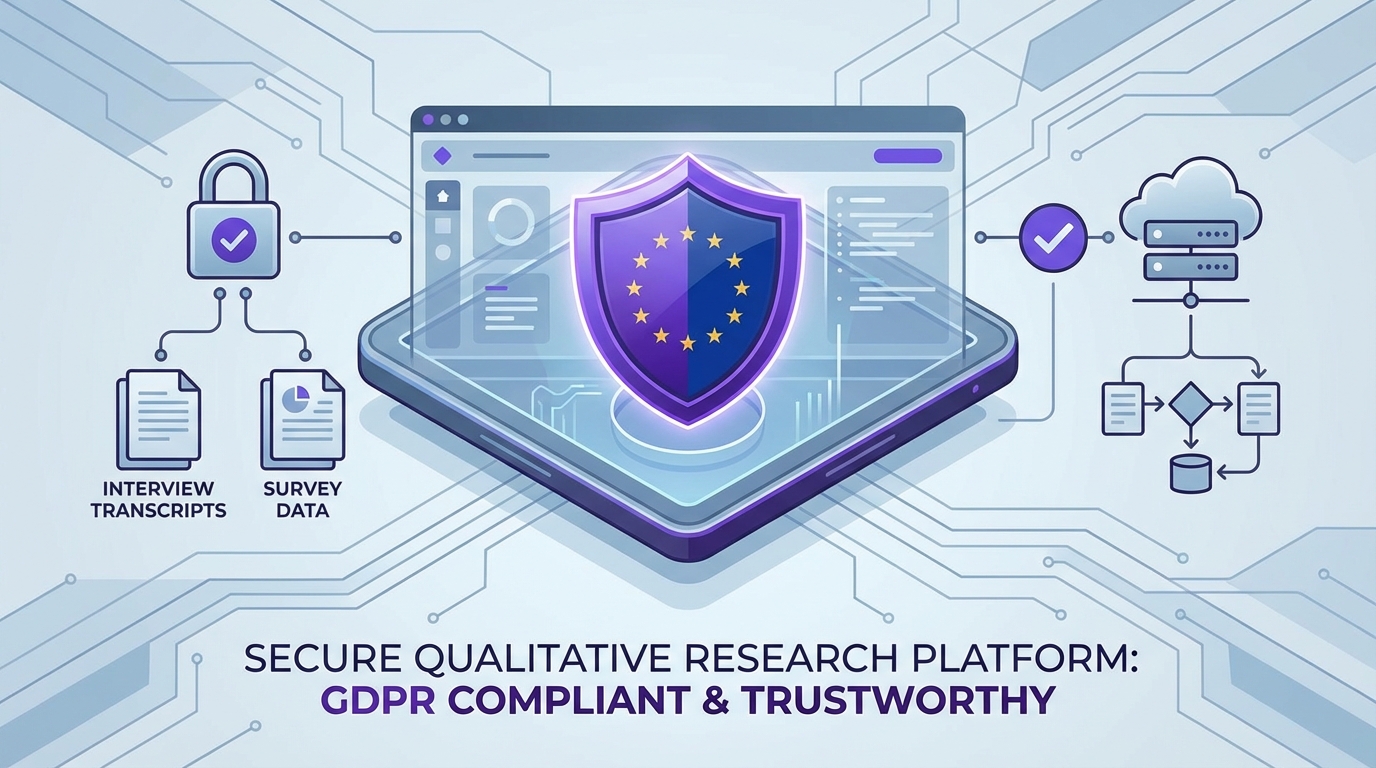
Qualz.ai's Approach to GDPR Compliance
Qualz.ai is designed with GDPR compliance built in:
Consent management: Built-in consent workflows for interviews and surveys, with documented consent records.
Data residency options: Choose where your data is stored based on your compliance requirements.
Participant rights: Easy fulfillment of access, rectification, and erasure requests.
Security: Enterprise-grade encryption, access controls, and audit logging.
DPA available: Standard data processing agreement for all customers.
Subprocessor transparency: Clear documentation of all subprocessors and their roles.
Common Compliance Mistakes
Avoid these common GDPR pitfalls in qualitative research:
Vague consent forms: "We may use your data for research" isn't specific enough. Detail exactly what you'll do.
No withdrawal mechanism: Participants must be able to withdraw easily. "Email us" isn't good enough—make it simple.
Unsecured storage: Dropbox or Google Drive without enterprise security features may not meet GDPR requirements.
Indefinite retention: "We'll keep data until our research is complete" isn't a retention policy. Specify timeframes.
Ignoring third parties: Every tool that touches your data (transcription services, analysis platforms, cloud storage) is a processor requiring a DPA.
Cross-border transfers without safeguards: Using US-based services without appropriate transfer mechanisms violates GDPR.
Practical Compliance Checklist
Before starting qualitative research:
- [ ] Identify lawful basis for processing
- [ ] Create GDPR-compliant information sheet
- [ ] Prepare consent forms covering all processing activities
- [ ] Establish secure data storage with appropriate access controls
- [ ] Set up retention and deletion schedules
- [ ] Document all processors and obtain DPAs
- [ ] Create procedures for handling data subject requests
- [ ] Train all researchers on data handling procedures
Need a research platform with GDPR compliance built in? Explore Qualz.ai's security features or contact us to discuss your compliance requirements.