The Efficiency Trap
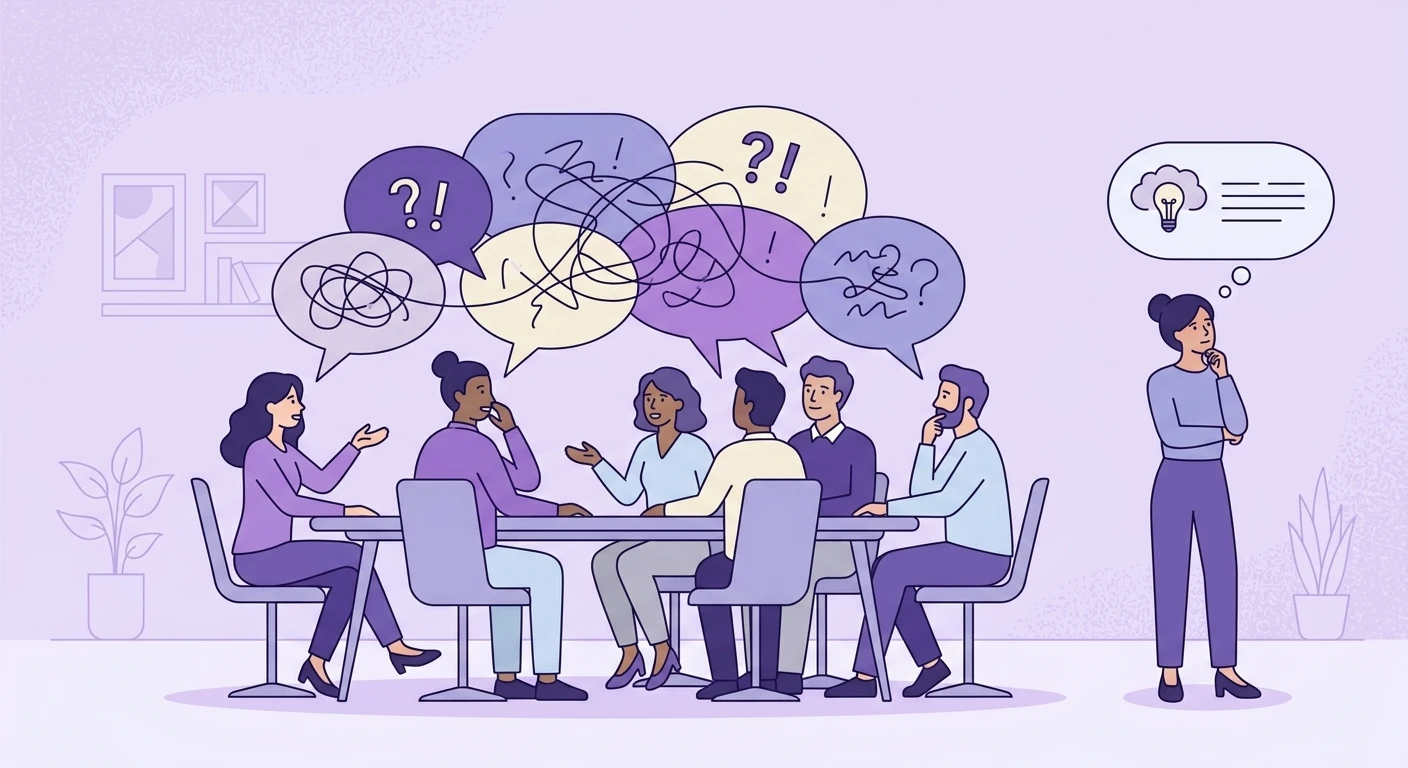
Focus groups remain popular because the math looks compelling: eight participants in ninety minutes versus eight individual interviews over two weeks. Product managers love them because they feel productive — real humans, real reactions, real-time synthesis. But the efficiency argument masks a fundamental methodological problem: groups do not produce eight individual perspectives. They produce one group perspective, shaped by whoever speaks first, loudest, or with the most perceived authority.
This is not a facilitation failure you can moderate away. It is a structural property of human social interaction. The moment you seat people together, you activate conformity mechanisms that operate below conscious awareness. Participants do not decide to agree with the dominant voice — they genuinely shift their perception to align with the emerging consensus.
How Conformity Corrupts Data
Solomon Asch demonstrated this sixty years ago with line-length judgments: people will deny their own sensory evidence to match group consensus. In UX research, the stakes are lower but the effect is stronger because product opinions feel less certain than perceptual judgments. When someone confidently declares "I would never use that feature," the participant who was about to say they liked it faces an immediate social cost for disagreeing.
Three specific mechanisms operate in every focus group:
Anchoring cascade. The first substantive opinion sets a gravitational center. Subsequent speakers position themselves relative to that anchor rather than generating independent reactions. If participant one says the navigation is confusing, participants two through eight are now evaluating "how confusing" rather than whether it is confusing at all.
Status contamination. Participants read each other's professional signals — job titles mentioned in introductions, confidence in speaking, industry vocabulary. Higher-status speakers receive more agreement regardless of insight quality. As research on how first impressions contaminate findings shows, these early signals reshape everything that follows.
Performance pressure. Focus groups are inherently performative spaces. Participants craft responses that sound intelligent to their peers, not responses that accurately represent their experience. The articulate critique wins social approval even when the quiet acceptance represents the majority experience.
The Facilitator Cannot Fix This
Experienced moderators know techniques to manage dominant speakers: round-robin prompts, written pre-responses, directed questions to quiet participants. These help at the surface level. But they cannot undo the conformity that has already occurred internally.
When you ask a quiet participant "What do you think?" after three people have criticized a design, their internal experience has already shifted. They are no longer accessing their original reaction — they are constructing a response in the context of what has been said. Even if they disagree, they will typically soften their disagreement: "I see what they mean, but I also thought..." The original uncontaminated reaction is gone.
This connects to broader challenges around what participants do not say — silence in groups is even more loaded than silence in individual interviews because it carries social meaning.
When Focus Groups Actually Work
Focus groups are not worthless — they serve specific purposes that individual interviews cannot:
Norm exploration. When you want to understand shared cultural assumptions about a category, groups reveal norms through the very conformity that corrupts individual data. How people perform their opinions in front of peers tells you about social expectations around a product category.
Concept stress-testing. Showing an early concept to a group lets you observe natural social reactions — the skeptic who voices what others are thinking, the enthusiast who sells the concept to peers. This mimics real-world word-of-mouth dynamics.
Language generation. Groups produce richer vocabulary through conversational building. One person's metaphor sparks another's refinement. This linguistic data is valuable for messaging and positioning work.
But for understanding individual experience, preference, or behavior — the core of UX research — groups produce systematically distorted data. The paired interviewing approach offers a middle ground: two participants provide social energy without the full conformity pressure of larger groups.
The AI-Moderated Alternative
Asynchronous individual interviews solve the conformity problem entirely. Each participant responds independently, without knowledge of others' answers. There is no anchor, no status hierarchy, no performance pressure. The trade-off has historically been scale: individual interviews take more time.
AI-moderated interviews eliminate that trade-off. You get individual depth at group-level efficiency. Each participant has a private conversation that adapts to their responses, probes their specific experiences, and captures uncontaminated individual perspective. The principles of AI governance and safety ensure these conversations maintain ethical standards while operating at scale.
Platforms like Qualz.ai run dozens of simultaneous individual interviews, each following an adaptive guide that goes deeper on relevant topics. You get the efficiency of a focus group with the data quality of individual interviews — without the facilitator paradox corrupting your findings.
Practical Decision Framework
Use focus groups when:
- You want to observe social dynamics around a topic
- You need language and framing, not individual truth
- The research question is about shared norms, not personal experience
- You explicitly want group interaction as data
Use individual interviews (AI-moderated or human-led) when:
- You need uncontaminated individual reactions
- The topic involves personal behavior or preference
- Participants vary in status, expertise, or confidence
- Accuracy matters more than efficiency
The facilitator paradox is not a problem to solve — it is a structural property to understand. Once you recognize that groups fundamentally alter individual data, you can choose the right method for your actual research question rather than defaulting to focus groups because they feel productive.
As enterprise teams adopt more sophisticated research approaches — the kind of compound research systems that combine multiple methods — the focus group finds its proper place: one tool among many, best used for the narrow set of questions where group dynamics are the data, not the noise.