The Problem With Treating Emotion as a Tag
When researchers code qualitative data, emotion usually gets one of two treatments: it is either folded into a thematic code ("frustration with onboarding" becomes part of the "onboarding" theme) or it receives a flat sentiment label (positive, negative, neutral). Both approaches lose the analytical signal that emotion carries independently.
Consider a participant who describes a workaround they built for a broken feature. The thematic code captures the workaround. The sentiment tag captures negativity. But neither captures the specific quality of resigned acceptance versus active anger — two emotional states that predict completely different future behaviors. The resigned user will churn silently. The angry user might become your most vocal advocate if you fix the problem.
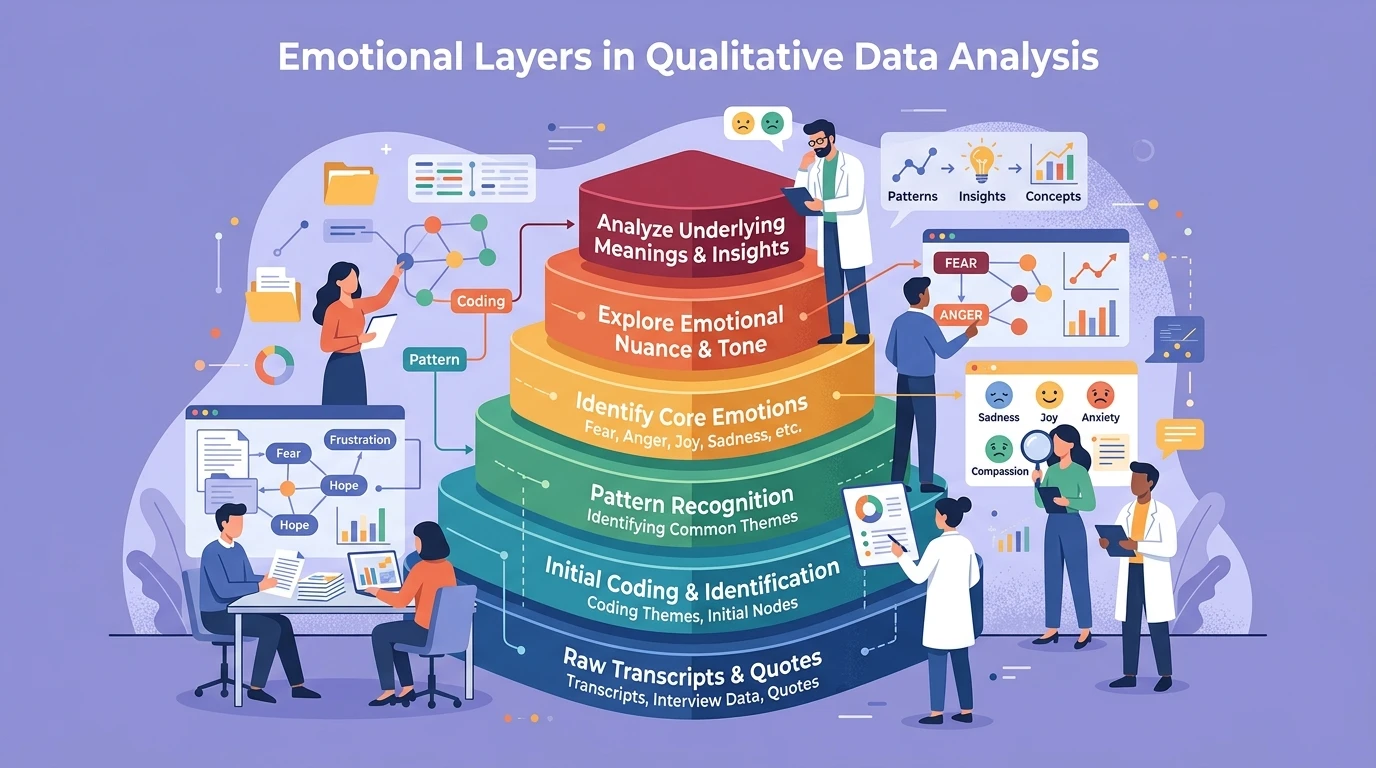
Emotional coding as a dedicated analytical layer means tracking affect as its own dimension, with its own codebook, its own saturation criteria, and its own analytical output. It is not a replacement for thematic analysis — it is a complement that reveals why people do what they do, not just what they do.
Why Emotion Gets Marginalized in Analysis
Three structural factors push emotion to the margins of qualitative analysis:
Positivist hangover. Even in qualitative research, there is an implicit hierarchy that privileges rational accounts over emotional ones. When a participant says "I chose this product because it integrates with Slack," that gets coded confidently. When they say "It just felt right," researchers often probe for the rational explanation underneath, treating the feeling as a surface phenomenon hiding a "real" reason.
Codebook design defaults. Most codebook templates organize around topics, features, or processes. Emotion appears as a modifier, not a primary category. You get "onboarding - frustrated" rather than "resignation - onboarding context." The hierarchical structure itself encodes the assumption that topic matters more than affect.
Reproducibility anxiety. Emotional coding feels subjective. Two coders might disagree about whether a participant sounds resigned or merely tired. This inter-rater reliability concern pushes teams toward safer, more "objective" codes — even though the entire field of qualitative research rejects the premise that objectivity is achievable or desirable.
Building an Emotional Codebook
An emotional codebook differs from a thematic codebook in structure. Rather than hierarchical topic trees, it uses dimensional frameworks:
Valence and arousal. The simplest approach codes emotion along two axes: positive-negative (valence) and high-low energy (arousal). This gives you four quadrants — excited enthusiasm, calm satisfaction, frustrated anger, and resigned disappointment — each predicting different user behaviors.
Appraisal patterns. More sophisticated coding captures what the participant appraises as causing the emotion. "Frustrated because blocked" differs from "frustrated because confused" — the first suggests a capability gap in the product, the second suggests an information architecture problem.
Temporal dynamics. Emotions shift within a single interview. Coding emotional transitions — the moment frustration shifts to resignation, or confusion becomes delight — often marks the exact interaction point where the product either wins or loses the user.
The key insight is that emotional codes should be applied independently of thematic codes, then cross-tabulated during analysis. This reveals patterns invisible to either layer alone: which themes consistently trigger which emotions, where emotional responses contradict stated preferences, and which product areas generate emotional intensity (positive or negative) versus emotional flatness.
Emotional Coding in Practice
A practical approach to emotional coding follows three steps:
First, conduct your standard thematic analysis pass. Get your topical codebook stable. This is not about replacing thematic analysis — it is about augmenting it.
Second, make a dedicated emotional pass through the same data. On this pass, you are listening exclusively for affect: tone of voice in audio, word choice in text, pacing changes, hedging language, emphatic repetition. Code each segment for the dominant emotional quality using your dimensional framework.
Third, create cross-tabulation matrices. Map emotional codes against thematic codes. The intersections reveal your most actionable insights: which product areas trigger the strongest negative affect, which features generate genuine delight (not just stated satisfaction), and where emotional responses diverge from rational assessments.
Teams using AI-powered qualitative analysis can accelerate this process significantly. Modern analysis tools can detect emotional valence in transcripts and flag segments where affect shifts dramatically — giving researchers a head start on the emotional coding pass rather than requiring fully manual identification.
When Emotional Coding Changes the Conclusion
The value of emotional coding becomes clearest when it contradicts thematic findings. In a recent project studying enterprise software adoption, thematic analysis showed strong satisfaction with a migration tool — participants described successful outcomes, praised specific features, and reported time savings.
But the emotional coding layer told a different story. The dominant affect during migration discussions was exhaustion and relief, not enthusiasm. Participants were satisfied the way someone is satisfied after finishing a root canal — glad it is over, not eager to recommend the experience. The thematic layer captured the outcome; the emotional layer captured the experience. The product team used the emotional data to redesign the migration wizard, reducing the emotional cost even though the functional outcome was already good.
This pattern — where thematic data says "working" but emotional data says "barely tolerable" — appears frequently when studying utilitarian tools. Users accomplish their goals and report satisfaction on surveys, but the qualitative context reveals the empathy gap that quantitative metrics cannot surface.
Cross-Domain Implications
Emotional coding matters beyond product research. In healthcare research, patient emotional responses during treatment discussions predict adherence better than stated understanding. In organizational research, the emotional texture of how employees discuss change initiatives predicts resistance patterns months before behavioral indicators appear.
The architectural challenge of tracking these emotional signals at scale mirrors what enterprise AI teams face when building observability for AI systems — you need a dedicated measurement layer that runs parallel to your primary analysis, capturing signals that the main system was not designed to detect.
For research teams building longitudinal programs, emotional coding across studies reveals meta-patterns: how does user affect toward your product category shift over time? Are your users becoming more resigned, more enthusiastic, or more indifferent? These emotional trajectories predict market dynamics that no single research study can capture alone.
Making Emotional Coding Sustainable
The biggest objection to emotional coding is time. Adding a full parallel analysis pass doubles the analytical workload. Three strategies make it sustainable:
Targeted application. Not every study needs emotional coding. Apply it where affect is likely to drive behavior: adoption decisions, churn moments, first-use experiences, and any context where participants describe choosing between alternatives.
AI-assisted detection. Use automated tools to flag emotionally intense segments for human coding. The machine identifies where to look; the researcher interprets what it means. This reduces the emotional coding pass from a full-data review to a targeted deep-dive.
Lightweight frameworks. Start with three codes — positive arousal, negative arousal, resignation — rather than a twenty-item emotional taxonomy. Expand only when you have evidence that finer distinctions matter for your specific research questions.
The goal is not to turn every study into an emotion research project. The goal is to stop treating affect as noise and start treating it as signal — because for your participants, how something feels is often the entire reason they do or do not do it.