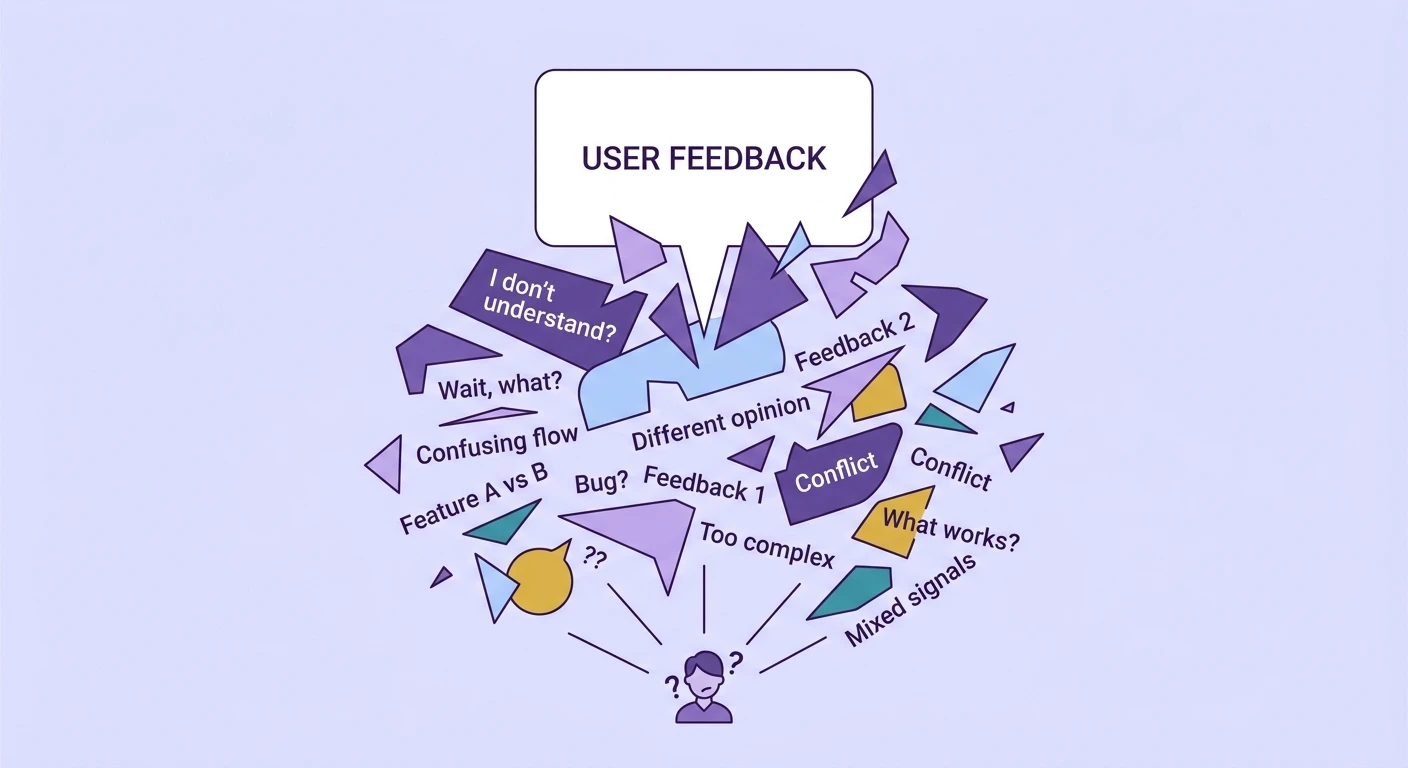
The Problem Nobody Notices Until Analysis
Here is a question that appears in interview guides every day: "How did you first discover the product, and what made you decide to try it?"
It sounds natural. It flows conversationally. And it produces data that is fundamentally compromised.
The participant will answer one half — usually the second, because recency bias favors the last thing they heard. You will nod, feel satisfied, and move on. During analysis, you will discover you have robust data about decision triggers and almost nothing about discovery channels. Except you will not discover this, because the transcript looks complete. The participant spoke fluently for ninety seconds. The gap is invisible unless you know to look for it.
This is the compound question trap: multi-part questions that create the illusion of complete data while systematically omitting half the information you need.
Why Researchers Default to Compound Questions
Compound questions feel efficient. You have sixty minutes and forty topics to cover. Combining related questions seems like responsible time management. It also mimics natural conversation — nobody in real life asks single-clause questions exclusively.
But efficiency in question count does not equal efficiency in data capture. A compound question that takes thirty seconds to ask and ninety seconds to answer produces less usable data than two simple questions that take fifteen seconds each to ask and sixty seconds each to answer. The math favors simplicity every time.
The deeper issue is cognitive. When a participant hears a compound question, their working memory must hold both parts while formulating a response. Most people cannot do this reliably. They anchor on whichever part resonates more — usually the part they have a ready answer for — and let the other part fade. This is not laziness or inattention. It is how human cognition handles information overload.
The Taxonomy of Compound Questions
Not all compound questions fail the same way. Understanding the failure modes helps you catch them in guide review:
Sequential compounds ask about two time points: "What was your initial reaction, and how has your opinion changed since then?" Participants typically answer about the present, because reconstructing past reactions requires more cognitive effort.
Causal compounds ask about both an event and its cause: "What happened when the feature broke, and why do you think it failed?" Participants default to description (what happened) and skip attribution (why), because description is factual while attribution requires speculation.
Evaluative compounds ask for both a rating and a justification: "How satisfied are you with the onboarding, and what would you change?" Participants skip the satisfaction assessment and jump straight to complaints, because criticism is more cognitively available than calibrated evaluation.
Comparative compounds ask about two different contexts: "How do you use this at work versus at home?" Participants pick the context they use more frequently and may not address the other unless prompted.
Each type produces a specific, predictable data gap. Once you recognize the pattern, you start seeing it everywhere in your transcripts.
The Cascading Effect on Analysis
The damage from compound questions extends far beyond individual responses. When you have twenty interviews and each contains six compound questions, you have up to 120 potential data gaps distributed randomly across your dataset. Some participants will answer both parts. Some will answer only the first part. Some only the second. The inconsistency makes thematic analysis unreliable because you are comparing unequal data across participants.
Consider a study exploring how teams adopt new project management tools. Your guide includes: "How did your team decide to switch tools, and what was the transition process like?" After twelve interviews, you have rich data about transition experiences from ten participants but decision-making process data from only four. Your analysis will overweight transition challenges relative to adoption triggers — not because transitions matter more, but because your question design collected more transition data.
This is how research synthesis debt accumulates silently. The data appears sufficient during collection but reveals structural holes during analysis, forcing you to either accept incomplete findings or go back for additional interviews.
AI-powered analysis tools can flag this pattern if they are designed to detect response completeness against question intent. As we explored in our discussion of how AI is reshaping qualitative analysis, automated systems can identify when responses address only a portion of what was asked — surfacing gaps that human analysts miss because the transcripts read smoothly.
The Fix: Decomposition Without Interrogation
The solution is not to make every question a terse single clause. That creates a different problem — interviews that feel like interrogations rather than conversations. The skill is decomposing compound questions while maintaining conversational flow.
Instead of: "How did you first discover the product, and what made you decide to try it?"
Ask: "How did you first hear about this product?" [Listen. Follow up.] Then: "And what tipped you from awareness to actually trying it?"
The transition between questions can be natural: "That is interesting — so once you knew about it, what made you actually take the step?"
For sequential compounds, separate the time points explicitly: "Take me back to when you first saw the new dashboard. What was your gut reaction?" Then later: "Now that you have been using it for three months, how do you feel about it?"
For evaluative compounds, lead with the evaluation and follow with the justification as a probe: "On the whole, how satisfied are you with the onboarding?" [Let them answer.] "What specifically drives that feeling?"
The principle is simple: one cognitive task per question. Discovery is one task. Evaluation is another. Attribution is another. Each deserves its own conversational space.
Detecting Compound Questions in Guide Review
Before any study launches, review your guide with a simple heuristic: if a question contains "and," "or," a comma splice, or could be answered with two distinct paragraphs addressing different topics, it is probably compound.
Better yet, try answering each question yourself. If you find yourself wanting to address the two halves separately, your participants will too — except they will only address one half and you will lose the other.
The most reliable detection method is pilot testing with a colleague who has permission to interrupt: "I notice that question asks two things. Which one do you want me to answer first?" If the pilot participant needs that clarification, your real participants need it too — they just will not ask.
Teams practicing research triangulation across multiple data sources are especially vulnerable to compound questions, because gaps in interview data may go unnoticed when other sources provide partial coverage. The compound question gap looks like a limitation of the method rather than a design flaw — which means it never gets fixed.
When Compound Questions Are Actually Fine
Not every multi-part question is problematic. Compound questions work when:
- Both parts are so closely related that answering one naturally addresses the other: "What did you click and what happened?" (action and immediate consequence)
- The question is an opening warm-up where completeness does not matter: "Tell me about your role and how long you have been in it"
- You are deliberately testing whether a participant can hold complexity (rare, and only appropriate in expert interviews)
The key distinction is whether you need separate, analyzable data from both parts. If both parts serve the same analytical purpose and you would code them together anyway, a compound framing is fine. If you need to analyze them separately — and you almost always do — decompose.
Building the Habit
Interviewers who have been asking compound questions for years will not stop overnight. The habit is deeply embedded in conversational norms. Three practices help:
- Highlight every "and" in your guide before piloting. For each one, ask: do I need separate data from what comes before and after this conjunction?
- Record yourself in pilot sessions and count compound questions that were not in the guide — the ones you improvise in the moment. These are harder to catch because they emerge from conversational flow.
- Use AI-assisted interview tools that can flag compound questions in real time. As adaptive interview systems mature, they can decompose multi-part questions automatically, asking each component separately while maintaining conversational coherence.
The payoff is immediate. Cleaner questions produce more complete data. More complete data produces more reliable analysis. More reliable analysis produces insights your team actually trusts. The compound question trap is one of the simplest methodological fixes available — and one of the highest-leverage changes you can make to your research practice.