Most teams approach competitive UX benchmarking the same way: open the competitor's product, click through the key flows, take screenshots, and fill out a heuristic evaluation spreadsheet. Maybe assign some Nielsen severity ratings. Maybe build a feature comparison matrix.
The output looks thorough. It is not. What you have captured is the surface layer of the competitor's design — the visual patterns, the interaction mechanics, the information architecture as it appears to a researcher clicking through with analytical intent. What you have missed is everything that actually determines whether users prefer that product over yours.
You have missed the mental models users bring to the competitor's interface. You have missed the workarounds they have developed for its shortcomings. You have missed the emotional relationship they have built with the product over months or years of daily use. You have missed the switching costs that keep them loyal despite known frustrations — and the specific moments of delight that make those frustrations tolerable.
This is the gap that qualitative competitive benchmarking fills. Instead of evaluating competitor products yourself, you study how real users experience them. The result is competitive intelligence that goes beyond "their checkout flow has fewer steps" to "users trust their checkout flow because the progress indicator reduces anxiety about accidental charges."
Why Heuristic Reviews Are Necessary but Insufficient
Heuristic evaluation has its place. It is fast, inexpensive, and effective at identifying obvious usability violations — broken affordances, inconsistent interaction patterns, accessibility failures, missing feedback states. Any UX team should maintain current heuristic assessments of key competitors.
But heuristic reviews have a structural limitation that no amount of rigor can overcome: they evaluate the interface through the lens of expert knowledge, not user experience. A trained UX professional sees a product differently than someone who uses it to accomplish real tasks under real constraints. The expert notices the inconsistent button styling. The user notices that the export function saves them twenty minutes every Friday afternoon.
This gap between expert evaluation and lived experience is where competitive advantage hides. Your competitor's product might violate a dozen heuristic principles and still command fierce loyalty because it solves a specific workflow problem better than anything else on the market. Conversely, a competitor might have a polished, heuristic-compliant interface that users find sterile and frustrating because it optimizes for learnability at the expense of efficiency for power users.
Qualitative research methods bridge this gap by capturing how users actually think about, use, and feel about competitive products — not how an expert thinks they should.
A Framework for Qualitative Competitive Benchmarking
The following framework combines three complementary qualitative methods to build a comprehensive picture of competitive UX. Each method captures a different dimension of the user experience that screenshots and heuristic checklists miss entirely.
Method 1: Contextual Inquiry With Competitor Users
Contextual inquiry — observing users in their natural work environment while they use the product — is the most powerful method for understanding competitive UX because it captures behavior in context. You see not just what users do, but why they do it, what they do before and after, and how the product fits (or fails to fit) into their broader workflow.
Recruiting participants. The hardest part of competitive qualitative research is finding people who actively use competitor products and are willing to let you watch. Three approaches work consistently:
First, screen from your own prospect pipeline. People who evaluated your product but chose a competitor are ideal participants — they can articulate comparison criteria and switching considerations. Your sales team likely has a list. Second, use panel services with product-usage screeners. Specify the competitor product by name, require active usage (not just past experience), and screen for frequency that indicates genuine engagement. Third, recruit from professional communities where your ICP congregates. LinkedIn groups, Slack communities, and industry forums often have members willing to participate in paid research sessions.
Structuring the observation. A competitive contextual inquiry session should run 60-90 minutes and follow the participant's natural workflow rather than a scripted task list. Ask them to show you how they accomplish their most common tasks. Watch for moments of friction they have normalized — workarounds so habitual that participants no longer register them as problems. Watch for moments of genuine satisfaction. Ask them to narrate their thought process as they work.
The key analytical question is not "what do they do?" but "what has this product taught them to expect?" Every product trains its users. Understanding what mental models a competitor has installed in your shared user base tells you what assumptions those users will bring to your product.
Method 2: Structured Comparative Interviews
While contextual inquiry captures behavior, structured interviews capture reasoning. Why did the user choose this product? What alternatives did they evaluate? What would make them switch? What would they miss most if forced to change?
Interview protocol design. Competitive interviews require careful protocol design to avoid two common failure modes. The first is leading questions that telegraph what you want to hear. "What frustrates you about Competitor X?" presupposes frustration. "Walk me through a recent time you used Competitor X for [task]" opens the door for frustration to emerge naturally — or not. The second failure mode is abstract preference questions. "Which product do you prefer?" yields shallow answers. "Tell me about the last time you had to [specific task] — which tool did you use and why?" yields rich competitive intelligence.
Structure the interview around jobs to be done rather than features. You are not trying to build a feature comparison matrix — you are trying to understand what progress users are trying to make and how well each product enables that progress. When a participant says they prefer a competitor's reporting feature, probe deeper. What specific report? For what audience? What decision does it inform? The job-level insight is strategically useful in ways that feature-level preference is not.
Cross-competitor comparison structure. If you are benchmarking against multiple competitors, do not ask participants to directly compare products. Instead, have each participant walk through the same set of jobs using their primary tool, then ask about moments where they considered alternatives or wished for different capabilities. Direct comparison questions produce rationalized answers. Job-focused narratives produce authentic competitive intelligence.
Method 3: Diary Studies for Longitudinal Competitive Insight
The limitation of both contextual inquiry and interviews is that they capture a snapshot — how users experience a competitor product during your research session. Diary studies capture the experience over time, revealing patterns that single-session methods miss entirely.
A competitive diary study asks participants to log their interactions with a competitor product over one to four weeks. Each entry captures what they were trying to accomplish, what happened, how they felt about the outcome, and whether they considered an alternative tool.
What diary studies uniquely reveal. Diary data surfaces the temporal patterns that drive competitive dynamics: which tasks push users toward workarounds, which moments trigger switching consideration, how satisfaction fluctuates across different use cases and time pressures. A user who rates a competitor product 8/10 in an interview might reveal through diary entries that their satisfaction drops to 4/10 every month-end when the reporting workflow breaks down under time pressure. That temporal insight is pure competitive gold — it tells you exactly when and why users are most receptive to alternatives.
Analyzing Competitive Qualitative Data at Scale
The framework above generates rich data — but also a lot of it. Ten contextual inquiry sessions, fifteen interviews, and eight diary study participants with three weeks of entries produce hundreds of pages of transcripts and logs. Manual analysis of this volume takes weeks, and the cross-method synthesis required to build a coherent competitive picture is cognitively demanding work that even experienced researchers find exhausting.
This is where AI-powered qualitative analysis transforms what is possible. The analytical challenge in competitive benchmarking is not just coding individual transcripts — it is identifying patterns that span methods, competitors, and user segments simultaneously.
Cross-competitor pattern identification. AI analysis can process all your competitive data simultaneously and surface patterns that sequential human analysis might miss. When users of Competitor A and Competitor C both describe the same workaround for a similar limitation — but use completely different language to describe it — AI pattern matching catches the structural similarity beneath the surface-level difference. This kind of cross-competitor synthesis is exactly where thematic analysis at scale delivers insights that manual coding struggles to produce within realistic timelines.
Segment-level competitive dynamics. Not all users experience competitors the same way. Power users, occasional users, and new users often have fundamentally different competitive assessments of the same product. AI analysis can segment your competitive data by user type and surface where competitive advantages and vulnerabilities differ across segments — intelligence that is critical for positioning and messaging but nearly impossible to extract manually from large qualitative datasets.
Sentiment and emotional mapping. Competitive advantage is often emotional, not functional. Users stay with products they trust, feel competent using, or have invested identity in mastering. AI sentiment analysis applied to competitive qualitative data maps the emotional landscape of competitor relationships — revealing not just what users think about competing products, but how they feel about them. These emotional patterns often predict switching behavior more accurately than feature-level satisfaction ratings.
Building a Competitive Intelligence Repository
Competitive UX benchmarking is not a one-time study — it is an ongoing intelligence function. Markets evolve, competitors ship updates, and user expectations shift. The qualitative competitive data you collect today becomes the baseline for detecting changes tomorrow.
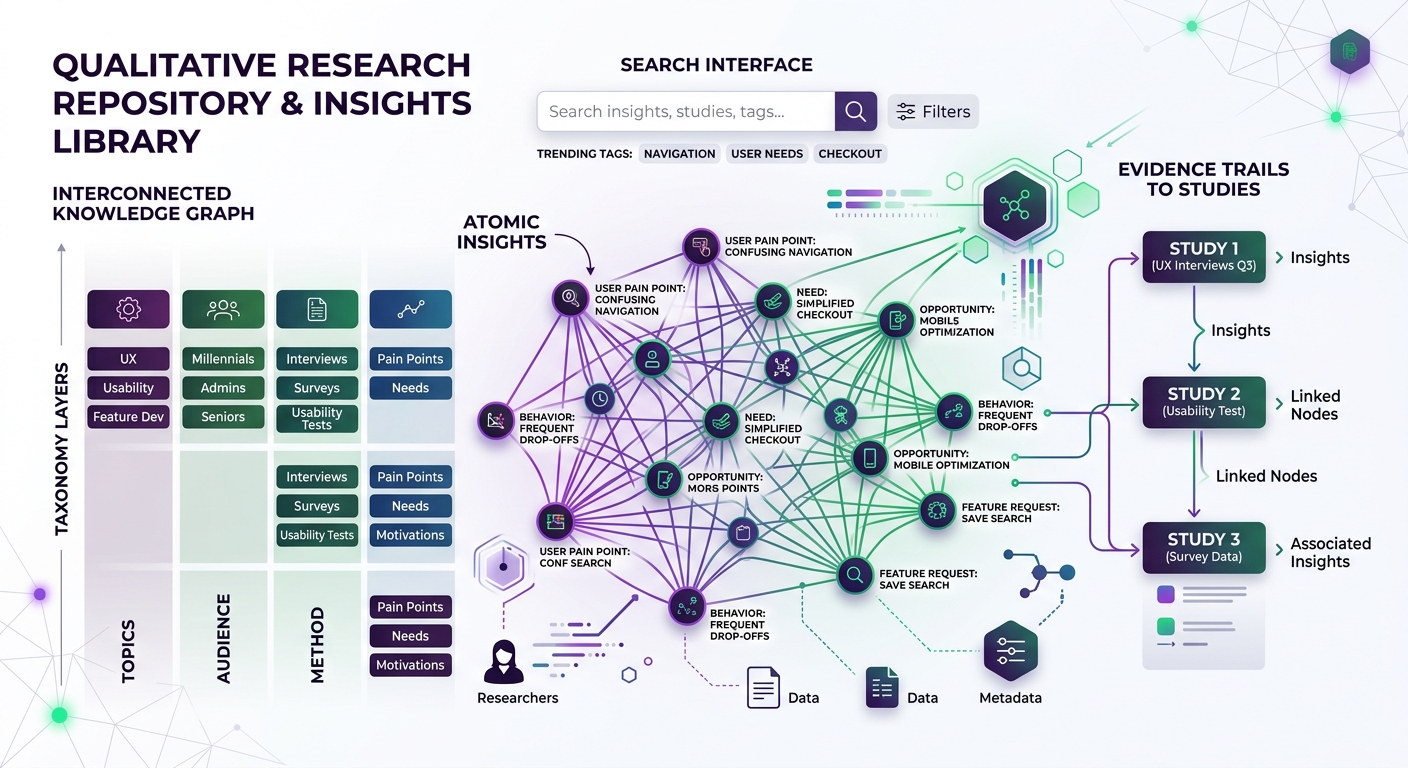
Build a research repository specifically for competitive intelligence. Tag findings by competitor, by job-to-be-done, by user segment, and by date. When a competitor ships a major update, you have the baseline data to assess whether it addresses the vulnerabilities you identified or opens new ones.
This repository also becomes a strategic asset for product roadmap decisions. When your team debates which feature to build next, competitive qualitative data provides evidence about which user jobs are underserved across the competitive landscape — not just which features competitors have or lack, but which outcomes users are struggling to achieve regardless of which tool they use.
From Competitive Intelligence to Competitive Advantage
The goal of qualitative competitive benchmarking is not to copy competitors or fill feature gaps. It is to understand the competitive landscape from the user's perspective deeply enough to make strategic choices about where to differentiate.
Screenshots tell you what competitors built. Heuristic reviews tell you how well they built it. Qualitative research tells you why users care — and where they wish someone would build something better.
That last insight — the unmet need that cuts across competitors, the job that every product in the category handles poorly, the emotional frustration that no current solution addresses — is where defensible competitive advantage lives. You cannot find it in a screenshot. You can only find it by talking to people.
Book an information session to see how Qualz helps teams run competitive qualitative research at scale — from structured interview protocols to AI-powered cross-competitor analysis that surfaces the patterns hiding in your competitive data.